
If you’ve been running Meta ads for your roofing business and wondering why your cost per lead keeps climbing while call quality stays flat, the problem is almost certainly your targeting approach. Understanding what is roofing Meta ads targeting means going well beyond picking a few homeowner interests and setting a zip code. Meta’s platform has shifted dramatically, and the roofing contractors winning in 2026 are the ones who’ve adapted their audience strategy to match how the algorithm actually works today. This guide breaks down every targeting layer, what changed, and exactly how to structure your campaigns for real results.
Table of Contents
- Key Takeaways
- What roofing Meta ads targeting actually means
- Geographic targeting and local creative
- How Meta’s platform changes affect your targeting control
- Best practices for audience structure and conversion tracking
- My take on what roofing targeting actually requires
- Ready to build a targeting strategy that actually converts?
- FAQ
Key Takeaways
| Point | Details |
|---|---|
| Four audience types power Meta roofing ads | Core, Custom, Lookalike, and Advantage+ audiences each serve a distinct role in prospecting and retargeting. |
| Hyper-local creative does the heavy lifting | Targeting your service radius with storm or neighborhood-specific messaging improves lead quality more than interest stacking. |
| Meta removed targeting exclusions in 2025 | First-party data and conversion feedback now replace exclusion rules as the primary audience control mechanism. |
| Separate cold and warm audiences | Keeping prospecting and retargeting campaigns in separate ad sets prevents intent confusion and improves optimization. |
| Feed real conversion data back to Meta | Sending booked inspection and sale events to Meta trains the algorithm to find leads worth your time, not just form fills. |
What roofing Meta ads targeting actually means
Most roofing contractors assume Meta ads targeting works like a filter. You pick homeowners, ages 35 to 65, interested in home improvement, living within 20 miles of your office, and Meta shows your ad to exactly that group. That’s not how it works anymore, and it hasn’t been for a while.
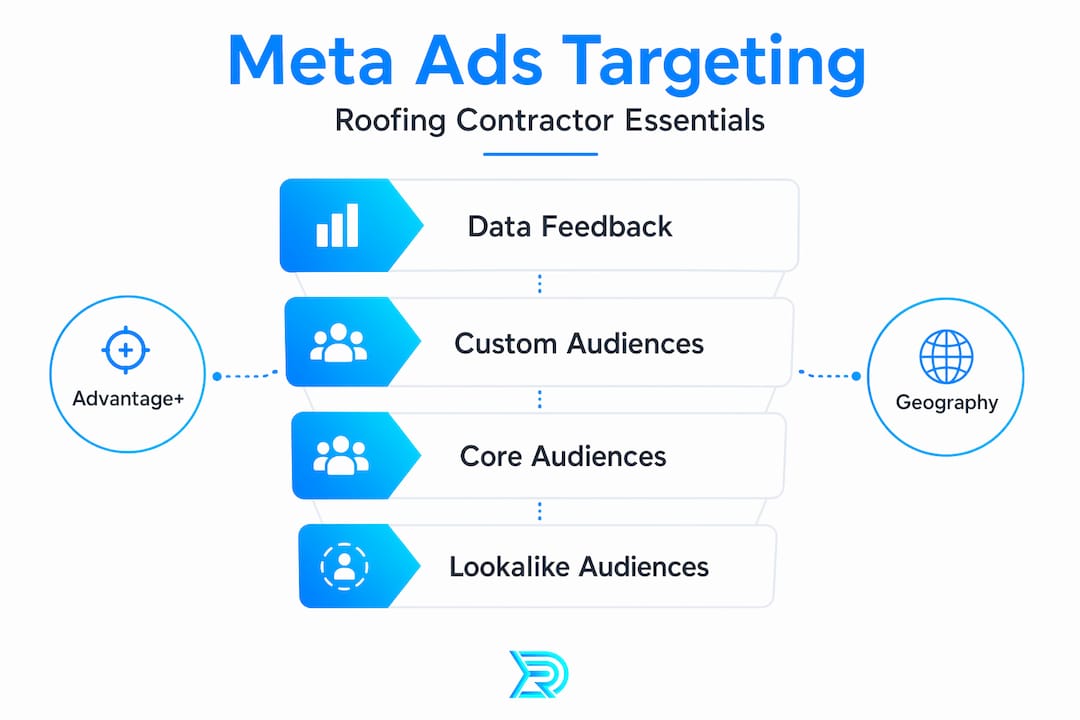
Meta Ads targeting for roofing involves four distinct audience layers, each built for a different job in your campaign funnel. Here’s how they break down:
-
Core audiences are built from demographics, interests, behaviors, and location. For roofers, this means targeting homeowners in specific zip codes, cities, or a defined service radius. You can layer in signals like home ownership status or general home improvement interests. Think of Core audiences as your cold prospecting base.
-
Custom audiences are built from your own data. Website visitors tracked by the Meta Pixel, past leads from your CRM, people who watched your video ads, or customers who booked an inspection. These are warm prospects. They already know you exist, and retargeting them with a specific offer converts at a much lower cost per lead than cold traffic.
-
Lookalike audiences take your Custom audience and find new people on Meta who share similar characteristics. Upload your list of past roofing customers, and Meta builds a pool of users who look like them. This is one of the most efficient ways to scale cold prospecting without guessing at interest stacks.
-
Advantage+ audiences represent Meta’s AI-driven targeting mode. You provide starting inputs, and the algorithm expands beyond them when it predicts better performance. Advantage+ targeting dynamically expands your reach beyond manual selections to optimize ad delivery for greater results.
The key distinction is prospecting versus retargeting. Cold prospecting uses Core, Lookalike, and Advantage+ audiences to find new homeowners who haven’t heard of you. Retargeting uses Custom audiences to re-engage people who visited your site, watched your ads, or submitted a form but never booked.
Pro Tip: Don’t run prospecting and retargeting in the same campaign. Mixing cold and warm audiences in one ad set confuses Meta’s optimization signal and inflates your cost per qualified lead.
Geographic targeting and local creative
For roofing businesses, geography is the most important targeting variable you control. You can’t install a roof in a city you don’t service, so getting your radius right is non-negotiable.
Here’s how to build a tight local targeting setup that actually works:
-
Define your true service area first. Most roofing companies can profitably service a 20 to 40 mile radius from their base. Map it out before you touch Meta Ads Manager. Use city names, zip codes, or a radius drop pin. Zip code targeting gives you the most precision, especially in dense metro areas where one zip code can mean a completely different neighborhood demographic.
-
Build storm-event creative when weather hits. When a hail storm or major wind event moves through your market, localized storm or repair messaging boosts engagement and lead quality dramatically. Run ads that name the specific city or neighborhood affected. “Did the April storm damage your roof in Katy, TX?” outperforms any generic roofing ad every time.
-
Match your offer to the homeowner’s situation. A neighborhood with homes built in the early 2000s is full of roofs approaching the end of their lifespan. An ad that says “Homes in [City] built before 2005 qualify for a free replacement inspection” speaks directly to that reality. Specificity signals relevance, and Meta rewards relevance with lower cost per click.
-
Avoid over-segmenting your geographic targeting. Splitting your budget across 15 different zip code campaigns sounds precise, but it starves each ad set of the conversion data Meta needs to optimize. Consolidate your service area into one or two geographic groups so each campaign gets enough signal to learn.
-
Let your creative do the audience filtering. For local contractors, geographic targeting plus locally tailored creative does most of the audience qualification work. A homeowner renting an apartment will self-select out of a roofing ad. You don’t need to exclude renters manually if your creative speaks directly to homeowners with specific roof concerns.
The combination of tight geography and relevant creative is what separates roofing contractors generating $30 cost-per-lead from those paying $120 for the same volume of unqualified calls.
How Meta’s platform changes affect your targeting control

This is where a lot of roofing advertisers get caught off guard. The platform you used two or three years ago is not the platform you’re using today.
Meta removed detailed targeting exclusions in March 2025, which fundamentally changed how advertisers control audience quality. Previously, you could exclude people who were renters, or exclude certain age groups, or stack exclusion rules to narrow your audience. That option is gone.
“With Meta’s removal of detailed targeting exclusions, advertisers must rely more on compliant experimentation and feedback to refine audience quality.” — PPC.land
What does this mean practically for your roofing campaigns? It means the old playbook of “interest stacking plus exclusion rules equals a perfect audience” no longer applies. You can’t engineer your way to a perfect audience through manual controls anymore.
There’s another layer to this. Advantage+ is not available for Special Ad Categories, which includes housing-related ads. If your roofing campaigns get classified under the housing special ad category, your targeting options become more restricted. You lose the ability to target by age, gender, and some geographic filters. This is a compliance issue, not just a performance issue.
The practical response to these changes is to lean harder on first-party data and conversion feedback. Your Meta Pixel, your CRM data, and your conversion events become the primary tools for audience quality control. Detailed targeting should be treated as flexible guidance rather than strict audience definitions. The inputs you provide point Meta in the right direction, but the algorithm will expand beyond them. Your job is to give it the right conversion signals so it expands toward homeowners who actually book, not just people who click.
Best practices for audience structure and conversion tracking
Getting your audience structure right is one thing. Getting your tracking right is what separates roofing campaigns that scale from ones that plateau at mediocre results.
Here’s what a well-built roofing Meta ads campaign structure looks like in practice:
-
Campaign 1: Cold prospecting. Use Core audiences with homeowner demographics and your service area, or a Lookalike audience built from past customers. Run your best creative for roof replacement, storm damage, or free inspection offers. This campaign’s job is to generate new leads.
-
Campaign 2: Warm retargeting. Build Custom audiences from website visitors in the last 30 days, video viewers who watched 50% or more of your ads, and past leads who didn’t book. Run a different offer here. A time-sensitive discount, a testimonial-heavy ad, or a “still thinking about it?” message works well for warm traffic.
-
Pixel and CAPI setup. Install the Meta Pixel on your website and set up Conversions API (CAPI) as a server-side backup. Track form submissions, phone call clicks, and most importantly, your confirmation page after a lead books an inspection. Without this, Meta is flying blind on what a good lead looks like.
-
Feed booked inspections back as conversion events. This is the step most roofing contractors skip. Feeding booked inspection and sale data back into Meta’s conversion tracking tells the algorithm to find more people like your actual customers, not just people who clicked your ad. Connect your CRM to Meta through a custom conversion event or a partner integration.
-
Test creative aggressively. Run at least three to five creative variations per ad set. Test different headlines, before-and-after photos, video walkthroughs, and social proof ads featuring real customer reviews. Successful roofing ads focus on geography, creative relevance, and first-party data rather than interest stacking.
Pro Tip: When you find a creative that’s generating leads at your target cost, don’t touch it. Build a new ad set to test against it instead of editing the winner. Editing resets the learning phase and can tank performance overnight.
Keeping cold prospecting and warm retargeting separate is not just good practice. It’s the difference between Meta optimizing toward your best leads and Meta optimizing toward whoever clicks cheapest.
My take on what roofing targeting actually requires
I’ve worked with roofing contractors across dozens of markets, and the ones who struggle most with Meta ads share a common belief: that if they just find the right interest combination, the leads will flow. They spend hours in Ads Manager stacking homeowner interests, adding behavioral filters, and trying to engineer a perfect audience. Then they wonder why their cost per lead is $90 and half the calls are from renters.
Here’s what I’ve learned. Meta’s algorithm is better at finding your customer than you are, but only if you give it the right feedback. The targeting inputs you provide are a starting point, not a guarantee. What actually trains the system is conversion data. When you tell Meta “this person booked an inspection, find more like them,” the algorithm goes to work. When you only tell it “this person filled out a form,” you get form fillers, not buyers.
I’ve also seen contractors waste significant budget on Advantage+ campaigns without proper conversion tracking in place. Advantage+ targeting needs quality signals to expand correctly. Without them, it expands toward cheap clicks, not qualified homeowners. You need to qualify roofing leads carefully before feeding that data back as a conversion signal, because garbage in means garbage out at scale.
The mindset shift that changes everything: stop thinking about targeting as audience control and start thinking about it as audience training. Your creative, your offer, and your conversion data are the real targeting tools in 2026.
— Results
Ready to build a targeting strategy that actually converts?
If you’ve made it this far, you understand that effective roofing Meta ads targeting is not about picking the right interests. It’s about audience structure, conversion tracking, local creative, and feeding real data back to Meta’s algorithm. That’s a system, not a one-time setup.
At Resultsdigitalus, we build and manage Meta ad campaigns exclusively for roofing contractors and specialty contractors. We handle everything from Pixel and CAPI setup to audience segmentation, creative testing, and CRM integration so your campaigns optimize toward booked jobs, not just clicks. Our roofing digital marketing services are built around one goal: qualified leads that turn into revenue. We also offer roofing PPC advertising that pairs Meta with Google to cover every stage of the buyer journey. No long-term contracts. No shared strategies with your competitors. Just results, every month.
FAQ
What is roofing Meta ads targeting?
Roofing Meta ads targeting is the process of defining which homeowners see your ads on Facebook and Instagram using audience tools like Core, Custom, Lookalike, and Advantage+ audiences. It combines geographic, demographic, and behavioral signals with first-party data to reach the most relevant prospects in your service area.
What audience type works best for roofing Meta ads?
For cold prospecting, Lookalike audiences built from past customers tend to perform best. For retargeting, Custom audiences built from website visitors and past leads deliver the lowest cost per booked inspection.
How has Meta’s 2025 targeting update affected roofing ads?
Meta removed detailed targeting exclusions in March 2025, which means roofing advertisers can no longer exclude specific audience segments manually. The focus has shifted to first-party data, conversion event tracking, and creative relevance to control lead quality.
Do roofing ads fall under Meta’s Special Ad Categories?
Some roofing campaigns may qualify as housing-related ads under Meta’s Special Ad Categories, which restricts targeting by age, gender, and certain geographic options. Check your campaign classification carefully, as this limits access to Advantage+ targeting features.
How do I improve lead quality from roofing Meta ads?
Feed booked inspection and sale events back into Meta as conversion signals through your Pixel and Conversions API. This trains the algorithm to find homeowners who actually hire roofers, not just people who click on ads. Pairing this with lead qualification from calls helps you filter out low-intent leads before they waste your sales team’s time.
