
TL;DR:
- Effective Google Ads for siding businesses rely on precise targeting, well-structured campaigns, and consistent optimization to generate quality leads.
- Preparing assets like dedicated landing pages, reviews, and verified profiles ensures higher conversion rates and builds trust.
Wasted ad spend is a silent killer for siding businesses. You set up a campaign, pour in budget, and end up with clicks from homeowners three states away, people searching for DIY tutorials, or leads so cold they never pick up the phone. The problem is rarely Google Ads itself. It is how the campaign is built, targeted, and measured. When you approach Google Ads the right way, with the right keywords, tight local targeting, and landing pages that earn trust fast, you can generate a steady stream of qualified homeowners and property managers who are actively looking for siding work right now. This guide gives you the full picture, from preparation to optimization to a smarter long-term strategy.
Table of Contents
- What you need before launching Google Ads for siding
- Building your campaign: Keyword strategy and local targeting
- Writing effective siding ad copy and landing pages
- Tracking, optimization, and verifying results
- Leveraging Local Services Ads (LSAs) for siding
- Our take: Why most siding ad budgets are wasted and how to break the mold
- Ready to maximize your siding leads? Work with the experts
- Frequently asked questions
Key Takeaways
| Point | Details |
|---|---|
| Prioritize granular keywords | Use specific local keywords and negatives to reduce wasted spend and attract qualified siding leads. |
| Match ads with landing pages | Ensure your ad copy and landing pages are tightly aligned to build trust and improve conversions. |
| Track and optimize weekly | Set up conversion tracking for all actions and optimize your campaigns every week for best ROI. |
| Leverage LSAs for trust | Local Services Ads provide top placement, pay-per-lead pricing, and the Google Guaranteed badge to boost call volume. |
What you need before launching Google Ads for siding
With the promise of high-quality leads, you first need the right foundation in place. Jumping into Google Ads without the proper assets in place is like knocking on doors with no business card and no portfolio. You might get a conversation, but you will not get a job.
Here is an overview of what “ready” looks like before you run your first ad:
| Asset | What “ready” looks like |
|---|---|
| Landing page | Service-specific page with photos, testimonials, and a short estimate form |
| Conversion tracking | Calls, form fills, and booked estimates firing correctly in Google Ads |
| Reviews | Minimum 10 recent Google reviews, ideally 20 or more |
| Google Ads account | Billing set, location targeting confirmed, conversion goals created |
| Ad assets (formerly extensions) | Sitelinks, call extensions, and location extensions active |
| Google Business Profile | Verified and linked to your Ads account for LSA eligibility |
The most overlooked asset is almost always the landing page. A message match from ad to landing page raises conversion rates significantly, meaning the headline on your landing page needs to mirror the exact promise in your ad. If your ad says “Vinyl siding installation in Austin,” the first thing a visitor should see on the page is a headline about vinyl siding in Austin, not a generic “We do it all” splash page.
Your landing page should include a short photo gallery showing finished projects, at least two or three written testimonials with full names, your warranties, your years in business, and a simple one-step form asking for name, phone, and project type. Long forms with eight fields kill conversions. Keep it tight.
Following Google Ads best practices for siding companies from the start will save you weeks of costly trial and error, especially around campaign structure and bidding setup. You can also draw useful lessons from studying a well-organized roofing Google Ads structure since the structural principles transfer well to siding campaigns.
Common prep mistakes to avoid:
- Sending all ad traffic to your homepage instead of a dedicated landing page
- Skipping call tracking and counting only form submissions as conversions
- Running ads before your Google Business Profile is verified
- Starting with a low review count that undercuts trust on arrival
- Setting location targeting to “presence or interest” instead of “presence only”
Pro Tip: Before your campaign goes live, load your Google Business Profile with recent reviews and verify your license and insurance credentials. These are prerequisites for earning the Google Guaranteed badge through Local Services Ads, which is a separate but powerful complement to your standard paid search campaign.
Building your campaign: Keyword strategy and local targeting
With your assets ready, you are now set to build a campaign with intentional outreach. Keyword strategy is where most siding campaigns either win or bleed money, and the difference comes down to specificity.
Broad match vs. granular keywords: a direct comparison
| Approach | Example keyword | Risk | Best use case |
|---|---|---|---|
| Broad match | siding | Very high wasted spend | Awareness only, large budgets |
| Phrase match | siding installation | Moderate, needs negatives | Brand building with some control |
| Exact match | vinyl siding repair Austin TX | Low waste, high intent | Direct lead generation campaigns |
| Granular clusters | fiber cement siding contractor near me | Minimal waste, highest intent | Primary lead gen focus |
Granular keyword strategies limit wasted spend by ensuring your ads only appear for searches that signal real buying intent. Someone typing “fiber cement siding installation Houston” is far more likely to call than someone typing “siding ideas.”
Here is a numbered process for building your keyword strategy from scratch:
- Start with seed terms. List every service you offer: vinyl siding installation, fiber cement siding, siding repair, siding replacement, LP SmartSide installation. These become your ad group themes.
- Add city and neighborhood modifiers. For each service, add your target cities, suburbs, and even popular zip codes. “Vinyl siding repair [city name]” is far more targeted than “vinyl siding repair.”
- Use keyword research tools. Google’s Keyword Planner shows you real local search volumes. Look for terms with at least 50 to 100 monthly searches locally before investing heavily.
- Organize into tightly themed ad groups. Each ad group should have one service and one location. Keep groups small, ideally five to ten keywords each.
- Build a thorough negative keyword list. Add terms like “DIY,” “free samples,” “how to,” “cheap,” “YouTube,” and “lowes” to block irrelevant traffic from day one.
- Layer geo-targeting on top. Set your campaign to target your actual service area, using radius targeting around your office or manual city and zip code selection.
You can find deeper execution details for Google Ads for siding campaigns to help you structure your account correctly before you spend a dollar.
Pro Tip: After your campaign runs for three to four weeks, export your search terms report and look for zip codes generating your best leads. You can then create a separate campaign targeting just those zip codes with a slightly higher bid, tightening lead quality even further.
Writing effective siding ad copy and landing pages
Next, with your targeting aligned, your ads and landing pages must seal the deal. Great targeting puts you in front of the right people. Great copy is what makes them choose you over the three competitors appearing in the same search.
Trust signals every siding ad and landing page should include:
- Google Guaranteed badge (if running LSAs)
- Number of Google reviews and your star rating
- Years in business in your local market
- Specific warranties offered (manufacturer and labor)
- Financing options, if available
- BBB accreditation or other local credentials
- Photos of local completed projects
“Ad copy should be benefit-driven and local, with clear offers, trust signals like reviews and warranties, and a sense of urgency. It must align directly with your landing pages to convert at the highest possible rate.” Google Ads for Siding Contractors: A Comprehensive Setup Guide
For headline writing, specificity always outperforms generics. Instead of “Quality Siding Services,” try “Vinyl Siding Installation in Dallas, TX.” Instead of “Call Us Today,” try “Free Estimate, 24-Hour Response.” Your description lines should reinforce the offer and add one trust signal: “Local, licensed siding pros with 500+ five-star reviews. Request your free estimate today.”
Your call to action matters more than most people realize. “Get a Free Estimate” consistently outperforms “Contact Us” for siding campaigns because it removes ambiguity. Homeowners know exactly what they are getting when they click.
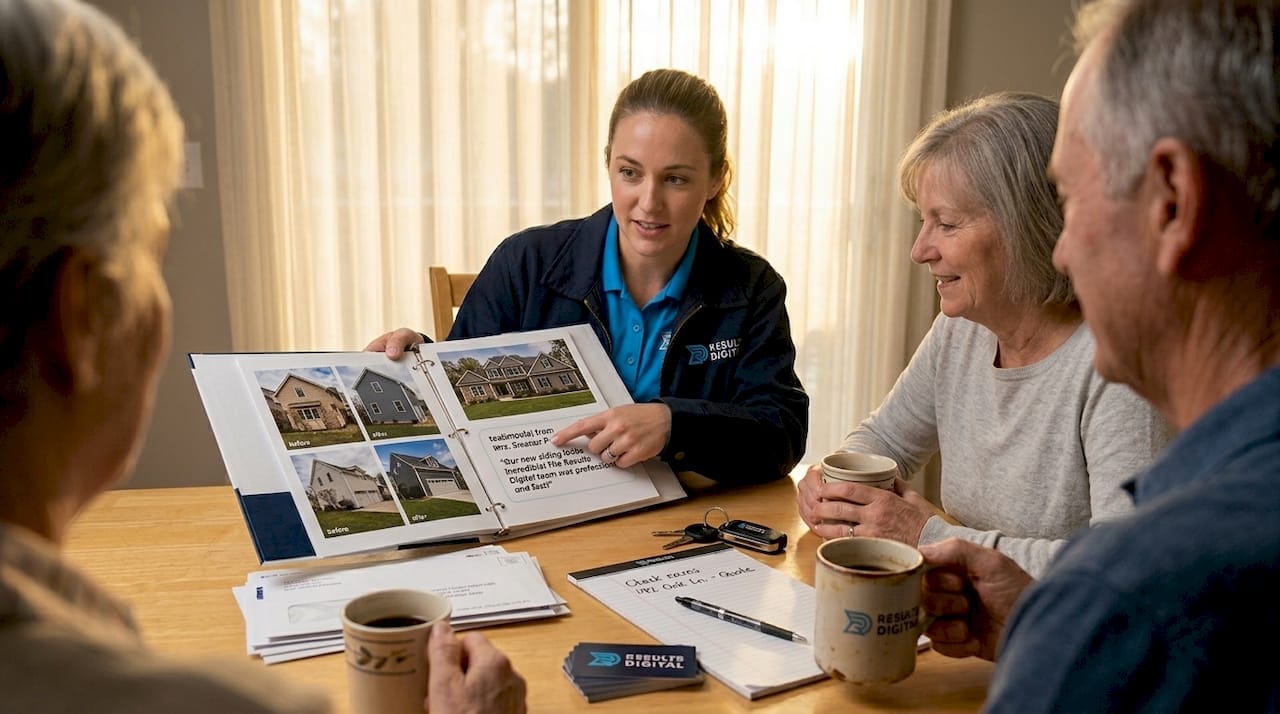
For landing pages, the structure that converts looks like this: bold, location-specific headline at the top, a before-and-after photo gallery in the middle third, a short testimonial directly above the form, and a single clear estimate request form. Nothing else. No navigation links pulling people away from the page.
If you want to diversify your paid strategy, exploring Facebook Ads strategies for siding is a smart complement to Google Ads, especially for visual content and retargeting past website visitors.
Pro Tip: Source before-and-after photos from specific neighborhoods in your service area and label them with the neighborhood name. A homeowner in Plano, Texas who sees “Recent project in Plano” with a recognizable street style is far more likely to trust you than one who sees a generic stock photo.
Tracking, optimization, and verifying results
Solid ads are only as strong as their long-term performance and learning, so here is how to track and improve consistently.
Setting up tracking and ongoing optimization:
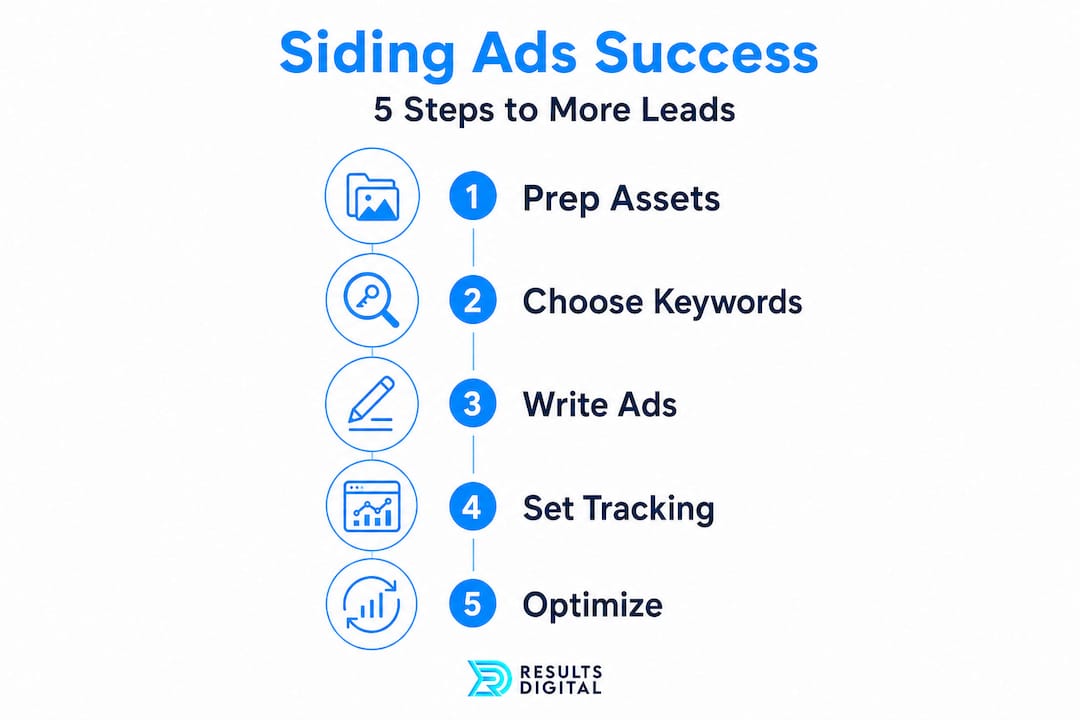
- Create conversion actions in Google Ads. Set up separate conversions for phone calls from ads, form submissions, and booked estimate confirmations. Each action tells a different part of the story.
- Install Google Tag Manager. Use it to fire conversion tags without needing a developer every time you make a change. This keeps your testing agile.
- Enable smart bidding after you have data. Wait until you have at least 30 conversions in 30 days before switching to Target CPA or Target ROAS bidding. Switching too early gives the algorithm too little to learn from.
- Run a weekly optimization check. Review your search terms report, pause keywords with high spend and zero conversions, test new ad variations, and check your quality scores.
- Use audience layering. Layer in-market audiences for home improvement and homeowner demographics to improve bid efficiency without restricting reach.
Over 70% of local searches come from Google, which makes your optimization efforts on this platform directly proportional to your lead volume. Ignoring weekly maintenance is one of the fastest ways to watch a strong campaign degrade over time.
A/B testing ideas to run continuously:
- Two different headline approaches: location-specific vs. benefit-specific
- Form with three fields vs. form with five fields
- Landing page with video testimonial vs. written testimonials only
- “Free Estimate” vs. “Schedule Your Estimate” as the primary CTA
- Pages featuring fiber cement photos vs. vinyl siding photos for matching ad groups
Tracking and optimization are not one-time tasks. Advanced conversion tracking for calls, forms, and booked estimates combined with smart bidding and weekly A/B testing is the operating rhythm that separates profitable campaigns from expensive experiments.
Leveraging Local Services Ads (LSAs) for siding
To further boost trust and visibility, there is one tool every siding marketer should know: Local Services Ads.
Why LSAs outperform standard PPC in several key ways:
- They appear above all other search results, including regular paid ads
- You pay only when a verified local lead contacts you directly, not per click
- The Google Guaranteed badge next to your name significantly increases trust
- They are especially powerful for high-intent searches like “siding repair near me”
- Google handles some of the targeting, reducing setup complexity
Prioritizing Local Services Ads for top placement, pay-per-lead billing, and the Google Guaranteed badge is one of the highest-ROI moves a siding company can make, particularly for emergency repair searches.
Steps to get started with LSAs:
- Apply through the Google Local Services Ads platform. Select “Home Services” and then “Siding” as your service category.
- Complete the verification process. Google will verify your license, insurance, and background check requirements based on your state.
- Build out your profile completely. Add photos, service descriptions, hours, and your service area in detail.
- Actively gather fresh reviews. Your ranking within LSA results is heavily influenced by your review count and recency, not just your bid.
- Monitor your badge status monthly. If your insurance lapses or a review policy is violated, Google can pause your badge, so maintain your credentials proactively.
Pro Tip: Treat your Google review pipeline as a core business process, not an afterthought. Send a review request by text immediately after every completed job while the experience is still fresh. Contractors who collect 10 or more reviews in their first LSA month see faster ranking improvements and lower cost per lead.
You can explore a broader set of local advertising strategies to see how LSAs, Google Ads, and organic search work together to dominate your local market.
Our take: Why most siding ad budgets are wasted and how to break the mold
Most siding companies that come to us have run Google Ads before. Some for months, some for years. And the story is almost always the same: a set-and-forget campaign built around three or four broad keywords, a homepage as the landing page, zero conversion tracking beyond click counts, and a monthly budget that quietly drains with little to show for it. This is not a Google Ads problem. It is a strategy problem.
Here is what we have seen work consistently: tight keyword clusters organized by specific service and city, landing pages that mirror ad copy almost word for word, and a weekly review habit that treats campaign data as a live advisor rather than a passive report. The guide to Google Ads for roofers applies nearly identical principles, and the results hold across exterior trades.
The conventional wisdom is that you need a big budget to compete in paid search. We disagree. We have seen siding campaigns with $1,500 monthly budgets outperform competitors spending $5,000, purely because of better targeting and stronger message match. Volume of clicks is the wrong metric. Cost per booked estimate is the only one that matters.
The honest truth is that most contractors do not have time to optimize weekly. They are running crews, managing material orders, and handling customer service. That gap between knowing what to do and having the bandwidth to do it is exactly where performance gets left on the table. Weekly insights beat yearly strategies every time. If you are not reviewing your search terms report and pausing waste weekly, you are essentially donating budget to Google’s bottom line.
Ready to maximize your siding leads? Work with the experts
Applying this strategy takes time, skill, and consistent attention. Getting everything right, from keyword architecture to landing page design to weekly optimization, is a full-time effort on top of running your business.
Results Digital specializes exclusively in helping exterior contractors like you generate high-quality local leads through Google Ads, Local Services Ads, and conversion-focused websites. Whether you want to understand the full Google Ads lead generation strategies we use, map out your lead generation workflow, or get clarity on local lead generation explained, we have the resources and the team to turn your ad spend into booked siding jobs. We work with only one siding company per market, so your competition cannot access the same strategy. Contact Results Digital today for a custom plan built around your service area and goals.
Frequently asked questions
What are the best keywords for Google Ads siding campaigns?
The most effective keywords are highly specific, local service terms like “vinyl siding repair near me” and “fiber cement siding installation [your city],” paired with a strong negative keyword list to block irrelevant traffic.
How do Local Services Ads (LSAs) help siding contractors?
LSAs secure top placement in search, charge only per lead rather than per click, and display the Google Guaranteed badge, which builds immediate trust with homeowners and increases call rates.
How should I track results from my siding ads?
Advanced conversion tracking for calls, form fills, and booked estimates gives you the clearest picture of ROI, and smart bidding strategies like Target CPA improve performance as data accumulates.
What is “message match” and why does it matter?
Message match from ad to landing page means your headline and offer stay consistent from the click to the page, which reduces bounce rates and increases the likelihood that a visitor converts into a real lead.
How often should siding ad campaigns be optimized?
Weekly optimization with A/B testing and pausing underperforming keywords keeps costs efficient and prevents good campaigns from quietly deteriorating over time.