

Target local markets: more roofing leads, lower costs
TL;DR:
- Targeted local marketing significantly reduces costs and increases conversion rates for roofing contractors.
- Using hyperlocal strategies like storm data and roof age analytics boosts lead quality and ROI.
- Combining SEO and PPC offers both immediate results and long-term growth in local markets.
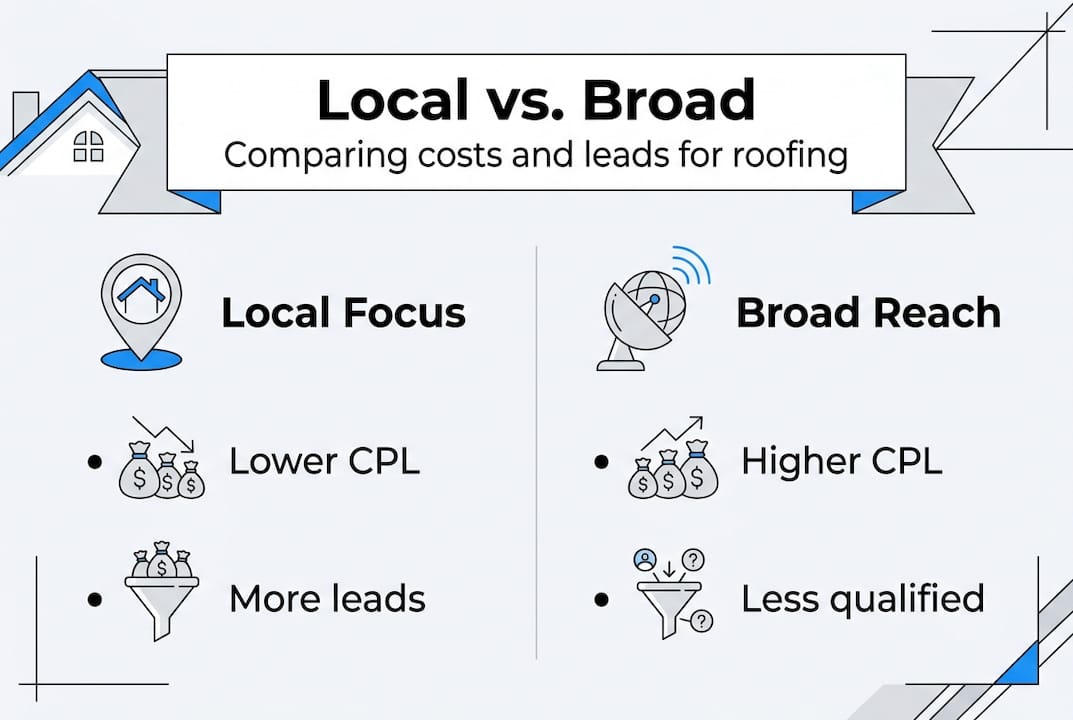
Most roofing contractors assume that casting a wider net means catching more customers. That logic feels right, but the numbers say otherwise. Broad national campaigns waste 62% of ad spend and hit a dismal 8% conversion rate, while hyperlocal targeting cuts cost per lead by 38% to 65%. For exterior contractors competing in tight local markets, this is not a small difference. It is the gap between a marketing budget that bleeds money and one that consistently fills your schedule with booked jobs. This article breaks down exactly why local targeting outperforms broad campaigns and how to use it to grow your roofing business.
Table of Contents
- The real cost of broad vs. local marketing
- Inside local targeting: Tools and strategies
- Long-term vs. immediate results: Local SEO vs. PPC
- Scaling up: Using multichannel strategies in local markets
- A fresh perspective: Why most contractors misunderstand local marketing
- Frequently asked questions
Key Takeaways
| Point | Details |
|---|---|
| Local targeting saves money | Focusing on local markets can slash cost per lead by up to 65% compared to national campaigns. |
| Leads are higher quality | Local campaigns yield more booked jobs from high-intent homeowners than broad advertising. |
| Multichannel wins | Using three or more marketing channels increases booked jobs by nearly 3x. |
| Data makes targeting powerful | Granular local data like hail maps and roof age greatly improves lead conversion rates. |
| SEO and PPC both have roles | Local SEO offers long-term compounding value, while PPC produces immediate but costlier leads. |
The real cost of broad vs. local marketing
When you run a broad or national campaign, you are paying to reach people who will never hire you. Someone three states away sees your Google Ad. A homeowner in a zip code you do not service clicks your Facebook post. Every one of those clicks costs you money, and none of them become jobs. That is the core problem with scale-first marketing for service businesses.
The contrast becomes very clear when you look at actual numbers. A broad PPC campaign in roofing can push your cost per lead (CPL) to $228 or higher. Narrow that same campaign to a defined local radius, and your CPL drops sharply because you are only paying to reach people who can actually become customers.
| Campaign type | Avg. cost per lead | Conversion rate | Wasted spend |
|---|---|---|---|
| Broad/national PPC | ~$228+ | ~8% | ~62% of budget |
| Local/hyperlocal PPC | 38-65% lower | Significantly higher | Minimal |
| Local SEO (organic) | Low long-term | Compounding growth | Near zero |
The table above tells a clear story. Broad campaigns waste 62% of your spend while delivering weak conversions. Local campaigns spend that same budget on people who are already in your market, already experiencing a roofing problem, and already searching for someone like you.
“The brands winning in local aren’t spending more. They’re spending smarter by targeting the right neighborhoods instead of entire regions.”
Your service area SEO guide can help you define exactly where to focus. And if you want to see how the best local contractors dominate their areas online, the strategies behind local market SEO domination are worth studying before your next campaign.
The bottom line is simple. Broad campaigns are built for brand awareness at scale, which is what national retail chains need. You are not a retail chain. You are a local expert who installs roofs, siding, and gutters in specific neighborhoods. Your marketing should reflect that reality.
Inside local targeting: Tools and strategies
With the benefits clear, let’s look at the core strategies that make local targeting so effective for roofing and exterior contractors.

The most powerful shift you can make is moving from demographic targeting to geographic and behavioral targeting. Instead of asking “who is my customer?” you start asking “where are my best customers right now and what just happened to their roof?”
Here are the key tools and tactics that make local targeting work:
- Hail maps and storm data: After a storm hits a specific zip code, demand for roofing services spikes immediately. Tools like Hail Trace let you identify exactly which neighborhoods were affected so you can run ads and door-knock campaigns before competitors even wake up.
- Roof age analytics: Platforms like EagleView and DataTree let you filter properties by roof age. A neighborhood full of 15 to 20 year old roofs is a gold mine of high-intent prospects, even without a storm event.
- Neighborhood-level PPC targeting: Google Ads allows radius targeting down to one mile. Use this to run campaigns around specific subdivisions rather than your whole metro area.
- Localized landing pages: Instead of sending all traffic to your homepage, build pages for each city or neighborhood you serve. These pages convert better because the message matches exactly what the visitor is looking for.
- Google Business Profile optimization: A well-optimized profile with location-specific content drives calls from people who are already nearby and ready to book.
Pro Tip: Granular data cuts CPL by 38% to 65%, but only if you actually use it to segment your campaigns. Do not run one ad to an entire city. Run five ads to five specific neighborhoods with messaging tailored to each.
Your local SEO guide walks through the technical foundations of ranking in specific markets. If you want to go deeper on service-based SEO for contractors, that resource covers how to structure your site to pull in local search traffic at every stage of the buying cycle. And to understand how SEO drives bookings for local service businesses, the data is surprisingly clear: organic local traffic converts at rates that rival paid campaigns when done right.
Long-term vs. immediate results: Local SEO vs. PPC
Now that you know how to target locally, it is time to weigh the balance between fast and sustainable results. SEO and PPC are both powerful, but they work on very different timelines and budget structures.
Local SEO builds authority over time. Your pages earn rankings through content, backlinks, and trust signals, and once they rank, they generate leads without you paying per click. It compounds. A blog post you write today can still pull in leads two years from now.
PPC is the opposite. You set a budget, launch a campaign, and leads start coming in within days. But the moment you stop paying, the leads stop. It is renting visibility rather than owning it.
| Channel | Time to results | Avg. CPL | Sustainability |
|---|---|---|---|
| Local SEO | 3-6 months | Low and declining | High, compounds over time |
| Google Ads (local PPC) | Days | ~$228+ | Low, stops when budget stops |
| Both combined | Immediate + long-term | Reduced overall | Very high |
Here is when to prioritize each:
- Use PPC when you need leads now. New business, slow season, or launching in a new market. PPC fills the gap fast.
- Use SEO when you are building for the next 12 to 24 months. It takes time, but the long-term compounding value of organic traffic far outpaces paid in the long run.
- Use both when you want to dominate. Businesses using three or more channels see 287% higher purchases than those relying on a single channel.
Pro Tip: Do not treat SEO and PPC as competing budget lines. Run them in parallel. PPC data tells you which keywords convert fastest, and you can use that intelligence to prioritize your SEO content strategy.
For a fuller picture of SEO benefits for contractors, the long-term numbers are compelling. And if you want to tighten up your paid side, these Google Ads lead generation strategies are built specifically for roofing and exterior businesses.
Scaling up: Using multichannel strategies in local markets
Once you have nailed your main marketing channel, expanding into multichannel tactics can drive even bigger gains. The data on this is not subtle. Contractors and service businesses using three or more channels generate 287% more booked jobs than those relying on a single source.
That gap exists because customers rarely convert on first contact. A homeowner might see your Facebook ad, then Google your business name, then read a review, then call. Each touchpoint reinforces trust. If you are only present in one channel, you are invisible for most of that journey.
Here are the channel combinations that work best for local roofing contractors:
- Local SEO plus Google Ads: Covers both organic and paid search. You show up twice on the same results page, which increases click-through significantly.
- Facebook Ads plus retargeting: Run neighborhood-targeted Facebook ads to build awareness, then retarget website visitors with offer-specific ads to pull them back.
- Email follow-up after quote requests: Most contractors never follow up with unconverted leads. An automated email sequence can recover 15% to 25% of those estimates.
- Google Business Profile plus review campaigns: Actively requesting reviews after every job boosts your local ranking and builds the social proof that converts fence-sitters.
- Direct mail plus digital: After a storm, hit affected zip codes with both a digital ad and a physical mailer. The combination outperforms either channel alone.
The key is consistency across all channels. Your messaging, offers, and brand visuals should look and feel the same everywhere a potential customer encounters you. Inconsistent branding at scale is worse than no scale at all.
For a broader view of marketing approaches for home services and the top SEO tips for home improvement businesses, both resources offer tactical depth on building a system that compounds over time.
A fresh perspective: Why most contractors misunderstand local marketing
Here is the uncomfortable truth most marketing agencies will not tell you: chasing reach is the fastest way to drain your budget without growing your business.
Contractors often equate visibility with volume. They think more impressions means more leads. But a thousand impressions from the wrong zip code produce zero jobs. Fifty highly targeted impressions in the right neighborhood can fill your week.
The real shift is mental. Local marketing is not a smaller version of national marketing. It is a completely different strategy built on specificity, proximity, and timing. The contractors who win are not the ones with the biggest ad budgets. They are the ones who know exactly which neighborhoods need a new roof right now and show up there first.
We have seen this pattern consistently. Hyperlocal targeting cuts CPL by up to 65% and produces more booked jobs, not because contractors spend more, but because they stop wasting money on people who will never call. If you want to see how this plays out across service categories, our breakdown of SEO results in local services shows the same pattern across HVAC, plumbing, and roofing alike.
Most competitors are still running broad campaigns and wondering why their CPL keeps climbing. That is your opportunity.
Want more booked jobs from search? Results Digital runs SEO: AI + Maps and Google Ads for contractors and trades, with one client per trade per market and month-to-month terms. Schedule a consultation to see if your market is open.
Frequently asked questions
How does local targeting reduce advertising costs for contractors?
Local targeting focuses your budget on high-intent homeowners in your actual service area, which is why CPL drops 38-65% compared to broad campaigns. You pay for fewer clicks but convert a much higher percentage of them.
What digital marketing channels should roofers prioritize locally?
Start with local SEO and Google Ads, then layer in email and social. Businesses using three or more channels see 287% more purchases than those using a single channel, so building a multichannel system early pays off fast.
Is local SEO more cost-effective for roofers than PPC?
Over time, yes. Local SEO compounds and keeps generating leads without ongoing spend, while PPC costs $228+ per lead and stops the moment you pause the campaign.
Can granular data like hail maps and roof age improve targeting?
Absolutely. Hail maps and roof age data identify neighborhoods with active roofing demand, so your ads and outreach reach the right homeowners at exactly the right moment.