

Local advertising guide for fire services: boost leads
TL;DR:
- Targeted local advertising significantly boosts fire protection companies’ organic growth and lead generation.
- Successful campaigns depend on understanding customer segments, optimizing trust signals, and quick follow-up.
- Combining PPC for emergencies with SEO and retargeting builds a sustainable, high-ROI growth system.
Fire protection companies that invest in targeted local advertising are seeing remarkable results. One industry analysis found that SEO and content marketing delivered 200% organic growth, 2.1 million impressions, and over 100 leads at nearly a 15% conversion rate. That kind of performance does not happen by accident. It comes from knowing your market, building the right digital foundation, and running campaigns that speak directly to the people who need your services most. This guide walks you through every step, from understanding your best prospects to measuring what actually moves the needle for your fire protection business.
Table of Contents
- Understanding the local fire services market
- Preparing your local advertising toolkit
- Executing high-ROI local advertising campaigns
- Verifying success and optimizing results
- Why most fire service advertising misses the mark and how to fix it
- Take the next step: power your fire service advertising
- Frequently asked questions
Key Takeaways
| Point | Details |
|---|---|
| Know your audience | Commercial buyers and facility managers drive the largest contracts in fire protection. |
| Prepare before launch | Solid foundations like mobile-friendly sites and accurate listings are essential for effective advertising. |
| Combine PPC and SEO | Use PPC for immediate results and SEO for steady long-term lead growth. |
| Track what matters | Focus on conversion rates, LTV, and response speed—not just traffic numbers. |
| Respond fast | Quick lead follow-up beats slower competitors and wins more contracts. |
Understanding the local fire services market
Before you spend a single dollar on advertising, you need to know exactly who you are trying to reach. Fire protection is not a one-size-fits-all industry. Your customer base splits into distinct groups, each with different needs, decision timelines, and buying behaviors.
The highest-value prospects are commercial facility managers and general contractors. These buyers control large contracts for sprinkler systems, suppression equipment, and annual inspections. Commercial facility managers and GCs drive the highest-value contracts, and leads in this segment typically shop two to three providers before committing. Trust built through compliance credentials and strong reviews is essential to winning their business.
Here is a quick breakdown of your core prospect groups:
| Prospect type | Primary need | How they find you |
|---|---|---|
| Facility managers | Annual inspections, compliance | Google search, referrals |
| Property managers | Residential/commercial installs | Local directories, reviews |
| General contractors | New construction fire systems | Industry referrals, LinkedIn |
| Homeowners | Residential suppression, alarms | Google Maps, social ads |
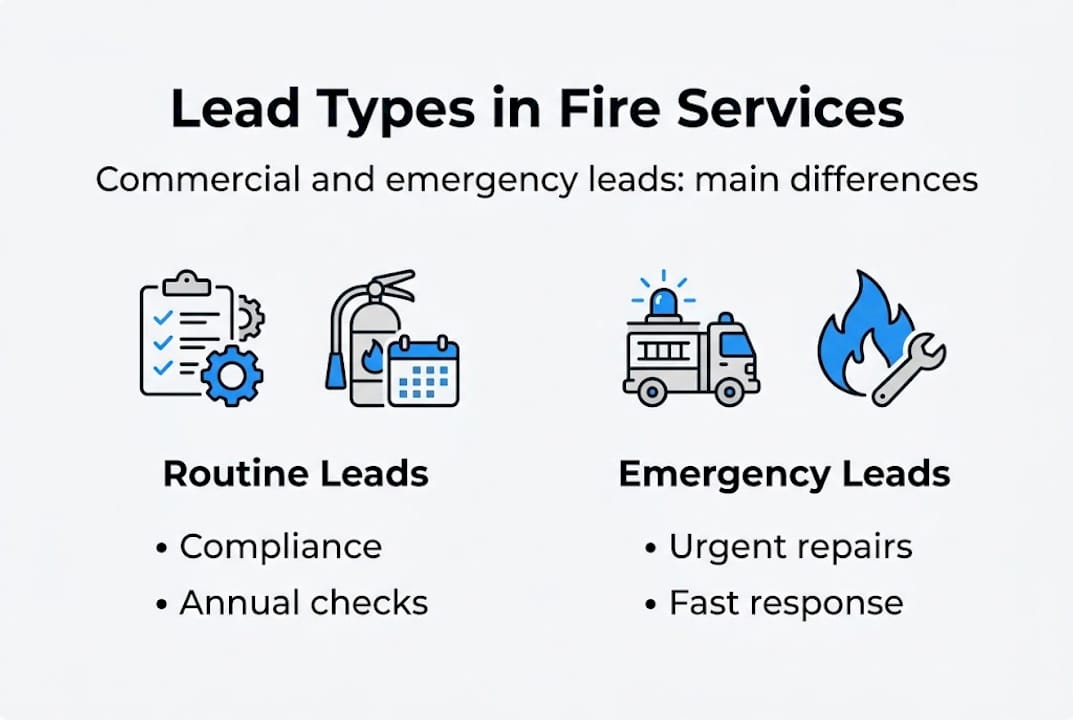
There is also a critical split between emergency service leads and routine service leads. Emergency calls, like a failed suppression system or a code violation notice, require fast response and immediate visibility. Routine services, like annual inspections or equipment upgrades, allow for longer nurture cycles. These two segments respond to completely different ad messages and platforms.
Referrals have always been the backbone of fire protection sales, but they have a ceiling. Word of mouth cannot scale predictably. You cannot control when a referral comes in or whether it matches your ideal job type. Effective local advertising for fire services fills that gap by generating a consistent, controllable flow of qualified leads.
Pro Tip: Set up two separate ad campaigns from the start, one targeting emergency service keywords and one targeting routine inspection and compliance keywords. This keeps your messaging relevant and your cost per lead lower.
“The fire protection market rewards providers who show up first and communicate trust clearly. Compliance credentials and verified reviews are not optional extras; they are conversion tools.”
Preparing your local advertising toolkit
With your market clearly defined, it is time to make sure your advertising foundation is solid. Running ads to a weak website or an unclaimed Google Business Profile is like pouring water into a leaky bucket. Fix the foundation first.
Here is a comparison of what a traditional launch looks like versus a digital-ready launch:
| Element | Traditional approach | Digital-ready approach |
|---|---|---|
| Business listing | Yellow Pages only | Google, Bing, Apple Maps, local directories |
| Trust signals | Word of mouth | Reviews, compliance badges, certifications |
| Website | Basic brochure site | Fast, mobile-optimized, with clear calls to action |
| Lead capture | Phone calls only | Forms, chat, click-to-call, landing pages |
Your website is the center of everything. Nearly 42% of traffic comes from mobile devices, which means your site must load fast and look clean on a phone screen. A slow or cluttered site kills conversions before they start. Review mobile optimization for local searches to understand what technical benchmarks your site needs to hit.
Here are the steps to get your toolkit ready before any campaign goes live:
- Audit your website for page speed, mobile responsiveness, and clear service pages.
- Claim and fully complete your Google Business Profile with photos, service areas, and hours.
- List your business on Bing Places, Apple Maps, and at least three local industry directories.
- Collect and display at least 15 to 20 Google reviews with responses from your team.
- Add compliance badges, certifications, and any relevant industry affiliations to your site.
- Set up conversion tracking so every call and form submission is recorded.
For fire protection providers, trust signals carry extra weight. A facility manager approving a $30,000 suppression system install is not going to choose a provider with three reviews and no credentials listed. Building out your fire protection SEO basics alongside your listings creates a compounding trust effect that referrals alone cannot replicate.

Pro Tip: Standardize your business name, address, and phone number, known as NAP, across every platform exactly the same way. Even small inconsistencies confuse search engines and hurt your local rankings.
Executing high-ROI local advertising campaigns
Your toolkit is prepped; here is how to put it into action, step by step.
Start with clear campaign objectives. Are you chasing emergency calls this quarter, or building a pipeline of inspection renewals? Your goal determines your platform mix and budget allocation.
Here is how to structure your campaign launch:
- Set your objective. Emergency leads need PPC. Long-term inspection pipeline needs SEO and email.
- Choose your platforms. Google Ads for search intent, Facebook for awareness and retargeting, local SEO for sustained visibility.
- Allocate your budget by expected ROI. SEO delivers 13 to 28x ROI over time, while PPC campaigns at $115 to $145 cost per acquisition are fully justified when contracts average $12,000 or more.
- Launch with tight geo-targeting. Limit your ads to the specific zip codes or radius where you actually want to work.
- Add negative keywords immediately. Block terms like “DIY fire alarm” or “fire safety training” to avoid wasted spend.
PPC is best for emergency leads and delivers results faster than SEO, but ongoing SEO is what builds a durable, compounding lead engine over time. The smartest fire protection advertisers run both in parallel. Explore fire protection PPC strategies and fire protection local SEO to see how each channel fits your growth goals.
Email and remarketing are often overlooked but incredibly effective for warm leads. A facility manager who visited your site but did not call is a high-value target. A simple retargeting ad or a follow-up email sequence can bring them back at a fraction of the cost of a cold click.
Watch for these common campaign problems and fix them fast:
- Low impressions: Your geo-targeting may be too narrow or your bids too low for the market.
- High cost per acquisition: Check your landing page conversion rate before raising your budget.
- Poor conversion rate: Mismatched ad copy and landing page messaging is usually the culprit.
- No calls despite traffic: Your phone number may not be prominently displayed or click-to-call enabled.
For a deeper look at budget and bidding strategy, review paid search tactics for fire services to see how top-performing fire protection campaigns are structured.
Verifying success and optimizing results
Launching campaigns is only the beginning. Delivering strong results requires ongoing measurement and smart adjustments.
Most fire protection businesses track website traffic and stop there. That is a mistake. Smart advertisers track conversion rates of 6.8% or higher, contract lifetime value, and response speed, not just page views. Vanity metrics feel good but do not pay invoices.
Here are the KPIs that actually matter, alongside industry benchmarks:
| Metric | Your target | Industry benchmark |
|---|---|---|
| Conversion rate | 6%+ | 6.8% |
| Cost per lead | Under $150 | $115 to $145 |
| Lead response time | Under 60 minutes | Under 1 hour |
| Customer lifetime value | $8,000+ | $12,000+ |
| Organic traffic growth | 20%+ per quarter | 200% annually |
Watch for these red flags in your campaign data:
- Conversion rate dropping below 4% means your landing page or offer needs work.
- Cost per lead rising week over week signals increased competition or poor ad relevance.
- Call volume flat despite traffic growth points to a phone number or trust issue on the page.
- High bounce rate on mobile means your site speed or layout is failing phone users.
For fire protection businesses, response speed is one of the most underrated metrics. A facility manager with a compliance deadline is not going to wait 24 hours for a callback. Review contractor SEO success tips for additional strategies on improving your overall lead quality alongside your ad performance.
Pro Tip: Follow up with new inbound leads within the first hour. Studies consistently show that response speed within 60 minutes dramatically increases close rates compared to waiting even a few hours.
Why most fire service advertising misses the mark and how to fix it
After working with service contractors across dozens of local markets, a clear pattern emerges. Most fire protection companies that struggle with advertising are not failing because of bad products or poor service. They are failing because of three fixable mistakes.
First, they chase impressions instead of conversions. An ad seen by 50,000 people means nothing if it does not generate calls. Second, they ignore follow-up speed. Companies that respond faster win more contracts, while those focused only on traffic volume without lead qualification consistently lose deals to faster competitors. Third, they run one generic ad to every audience, mixing emergency service messaging with routine inspection offers in the same campaign.
The top-converting fire service advertisers do things differently. They segment ruthlessly, track obsessively, and respond immediately. They also invest in fire protection SEO best practices as a long-term asset, not just a quick fix.
“The fastest responder often wins the contract, not always the cheapest.”
This is the uncomfortable truth most agencies will not tell you. Speed of follow-up matters more than creative ad design in most local fire service markets. Set up instant notifications for every new inbound lead, whether it comes from a form, a call, or a chat message, and respond before your competitors even see the notification.
Take the next step: power your fire service advertising
If you are ready to elevate your fire service advertising, our proven solutions can help you win more customers and grow your business with confidence.
Results Digital specializes in digital marketing for fire protection companies that want real, measurable growth. From high-converting landing pages to tightly targeted Google Ads for fire services, every strategy we build is designed around your specific market and service mix. We work with only one fire protection company per market, so your growth is never competing against a client we also serve down the street. Reach out today to find out if your market is still available and how we can build a custom advertising program that fills your schedule with quality jobs.
Frequently asked questions
What advertising methods work best for local fire services?
PPC drives instant emergency calls while local SEO builds a sustainable organic pipeline, and combining both consistently delivers the highest ROI for fire protection companies.
How can I track the results of my advertising?
Monitor conversion rates, lead response speed, and customer retention rather than only tracking clicks or impressions, because smart tracking measures bottom-line results that actually reflect business growth.
Are referrals enough to grow my fire protection business?
Referrals help but are rarely enough for consistent growth. Referrals are limited for reaching growth targets compared to digital lead streams that run around the clock.
What’s the main mistake to avoid in fire service advertising?
Focusing on vanity metrics like traffic while ignoring response speed leads to missed deals, since speed of follow-up determines win rate more than traffic volume ever will.
Do I need separate campaigns for emergency and routine fire services?
Yes. Segmenting by service type improves ad relevance and cost-effectiveness, ensuring each audience sees messaging that matches their specific urgency and buying intent.