
TL;DR:
- Transparent reporting provides full access to real marketing data, not curated summaries.
- Key metrics include cost per lead, conversion rate, ROI, and call volume, focusing on revenue impact.
- Red flags include lack of account access, vague explanations, and reports focused on impressions.
Most roofing contractors have no idea where their leads actually come from. They pay an agency every month, get a PDF with some charts, and hope for the best. That guessing game is expensive. Small businesses overpay by 30 to 50% when they lack visibility into how their marketing money is spent. This guide breaks down what transparent reporting really means, which numbers you should demand, and how to spot the agencies that hide behind vague dashboards and cherry-picked stats. If you want to grow your roofing business with confidence, you need to own your data.
Table of Contents
- What is transparent reporting in digital marketing?
- Key metrics and data points that matter
- The transparent reporting process: step-by-step
- Red flags and expert tips: Spotting transparency (or the lack of it)
- A new era: Why transparency drives stronger roofing businesses
- Get transparent digital marketing for your contracting business
- Frequently asked questions
Key Takeaways
| Point | Details |
|---|---|
| Transparency builds trust | When you see every number and result clearly, you make more confident marketing decisions. |
| Track what truly matters | Focus your reporting on CPL, conversion rates, ROI, and real leads, not just website clicks or impressions. |
| Demand direct dashboard access | Insist on owning your marketing data and understanding every report to avoid overpaying for underperformance. |
| Ask tough questions | Look for clear answers and be wary of any agency that avoids giving you full transparency. |
| Transparency drives growth | When your reporting is clear and honest, your lead generation—and your business—grows faster. |
What is transparent reporting in digital marketing?
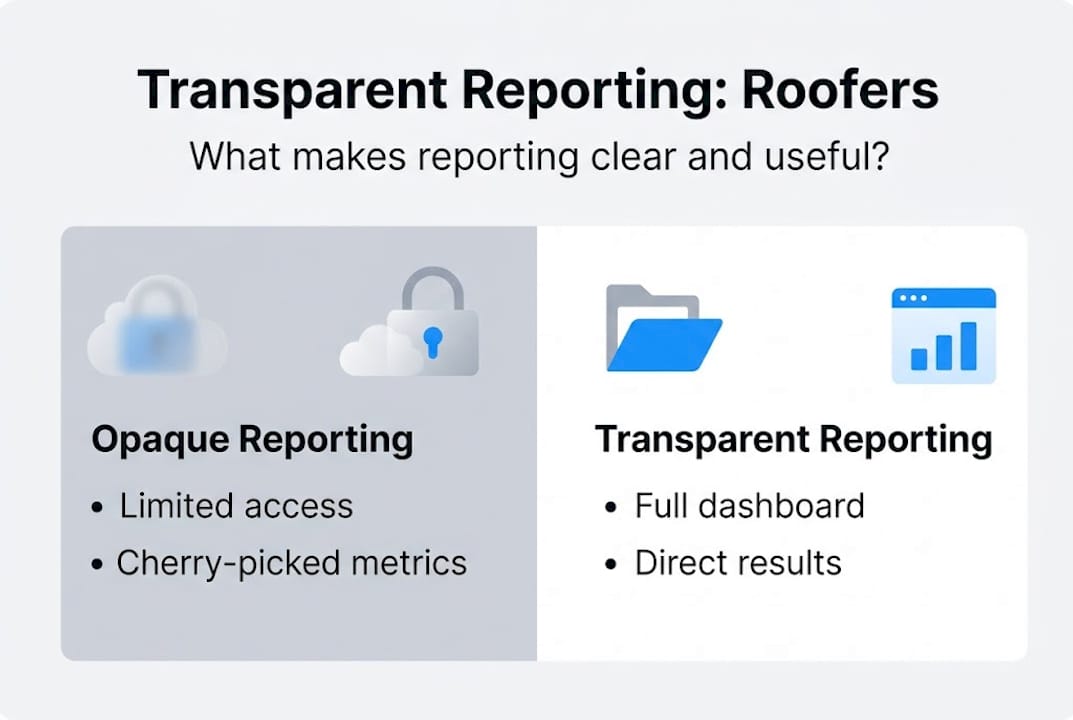
Transparent reporting means you get full, unfiltered access to your marketing data in plain language. Not a curated summary. Not a highlight reel. The real numbers, explained clearly, updated regularly, with honest context around what is working and what is not.
Most agency reports do not meet that bar. They tend to show you the metrics that look good, like impressions and clicks, while burying the numbers that actually matter, like cost per lead and booked jobs. Some agencies add hidden markups to ad spend and never disclose them. Others give you access to a dashboard they control, meaning they can change what you see at any time.
Digital marketing transparency for roofers is not just a nice-to-have. It is the foundation of a healthy agency relationship. When you have direct access to your own Google Ads account, your own analytics, and your own call tracking data, there are no surprises. You see exactly what you paid for and exactly what you got.
Here is a quick comparison of opaque versus transparent reporting:
| Feature | Opaque reporting | Transparent reporting |
|---|---|---|
| Dashboard access | Agency-controlled | Direct client access |
| Ad spend visibility | Hidden markups possible | Full spend breakdown |
| Metrics focus | Impressions, clicks | Leads, calls, booked jobs |
| Data explanations | Minimal or none | Clear narrative with context |
| Reporting frequency | Monthly PDFs | Real-time or weekly updates |
| Account ownership | Agency owns it | Client owns it |
Transparent models enable faster pivots and better ROI, while traditional agencies often rely on information gaps to maintain control over the relationship. When you cannot verify the numbers, you cannot challenge them. That imbalance costs roofing contractors real money every single month.
Key features of genuinely transparent reporting include:
- KPI definitions written in plain language, so you know exactly what each number means
- Source validation, so you know leads came from your Google Ads campaign and not a bot
- Business outcome focus, meaning the report ties marketing activity to actual revenue or job bookings
- Honest explanations of underperformance, not just wins
When your agency explains a bad month as clearly as a good one, that is transparency. It builds trust and gives you the information you need to make better decisions with your budget.
Key metrics and data points that matter
Not all numbers are created equal. Some metrics make you feel good. Others actually help you grow. As a roofing contractor, you need to know the difference fast.
The metrics that drive real decisions are the ones tied directly to revenue. For roofing contractors, a target CPL sits around $350, conversion rates typically range from 5 to 12.5%, ROI can reach 8 to 9x with the right campaigns, and daily call volume is one of the clearest signs your marketing is working. These are the numbers that tell you whether your budget is producing jobs.

Here is a breakdown of the metrics that matter most versus the ones that are mostly noise:
| Metric | Why it matters | Benchmark for roofers |
|---|---|---|
| Cost per lead (CPL) | Shows what you pay per real inquiry | Around $350 |
| Conversion rate | % of visitors who become leads | 5 to 12.5% |
| ROI | Revenue generated per dollar spent | 8 to 9x |
| Call volume | Direct indicator of campaign activity | Track daily |
| Impressions | Brand awareness only | Not a growth metric |
| Page views | Traffic indicator, not revenue | Secondary only |
You can track lead generation for local contractors more effectively when you focus on these outcome-based numbers rather than surface-level stats.
Here are the top metrics to demand in every report:
- Cost per lead (CPL): How much you spent to generate each inquiry, broken down by channel.
- Conversion rate: The percentage of website visitors or ad clicks that turned into actual leads.
- Call tracking data: Calls tied directly to specific campaigns, keywords, or landing pages.
- Return on investment (ROI): Revenue or job value generated compared to total marketing spend.
- Attribution by channel: Which platform, Google Ads, Facebook, or organic search, drove each lead.
Vanity metrics like total impressions, social media likes, and raw traffic numbers are not useless, but they should never be the headline of your report. If your agency leads every conversation with how many people saw your ad, that is a warning sign. You need to track contractor marketing metrics that connect directly to your bottom line.
Pro Tip: Ask your agency to show you key contractor metrics side by side with your actual job bookings. If the two numbers do not move together, something in the reporting is off.
A good dashboard should visualize trends over time, not just point-in-time snapshots. Seeing your CPL drop from $480 to $310 over three months is far more useful than a single monthly number with no context.
The transparent reporting process: step-by-step
Knowing which metrics matter is one thing. Having a repeatable process to track, validate, and act on them is another. Here is how a transparent reporting process should work for a roofing or exterior contracting business.
Key methodologies include setting goal-based KPIs, cleaning data, using real-time dashboards, and explaining results honestly. That framework maps directly to the steps below.
- Define your goals and KPIs upfront. Before any campaign launches, agree on what success looks like. Is it 20 qualified leads per month? A CPL under $400? A specific number of booked estimates? Write it down and tie every report back to those targets.
- Set up proper tracking tools. This means UTM parameters on every link, call tracking numbers assigned to each campaign, and CRM integration so leads are matched to their source. Without this layer, your data is guesswork.
- Validate the data regularly. Data cleaning is not glamorous, but it matters. Bot traffic, spam form fills, and misdirected calls can inflate your numbers and make a weak campaign look strong. Your agency should flag and filter these automatically.
- Build a real-time or weekly dashboard. Monthly reports are too slow for active campaigns. A live dashboard lets you catch problems early, like a sudden CPL spike or a drop in call volume, before they cost you thousands.
- Review results with honest narrative. Every reporting session should include a plain-language explanation of what happened, why it happened, and what changes are being made. Wins and losses both deserve equal attention.
- Adjust and repeat. Transparent reporting is not a one-time setup. It is a continuous loop of measuring, explaining, and improving.
Pro Tip: Insist on owning every account directly, your Google Ads account, your analytics property, your call tracking numbers. If your agency disappears tomorrow, you should still have full access to all your tracking marketing results and historical data.
“The best reporting does not just show you what happened. It tells you why it happened and what you are going to do about it.”
A solid lead generation workflow depends on this kind of reporting discipline. When every step is documented and validated, you can scale what works and cut what does not without wasting months figuring out why the numbers look wrong.
Red flags and expert tips: Spotting transparency (or the lack of it)
Not every agency that talks about transparency actually practices it. Some use the word as a selling point while keeping you at arm’s length from your own data. Here is how to tell the difference before you sign anything.
Privacy changes across Google and Meta have made attribution harder for everyone. PPC measurement now relies on modeling and redundancy due to the loss of complete click data, which means a trustworthy agency needs to be even more upfront about how they are filling those data gaps, not less.
The biggest red flags to watch for:
- Defensive responses to direct questions. If you ask where a lead came from and the answer is vague or evasive, that is a problem.
- No direct account access. You should be able to log into your Google Ads, Meta Ads, and analytics accounts at any time without asking permission.
- Reports dominated by impressions and reach. These metrics cost nothing to inflate and mean very little for a local roofing company trying to book jobs.
- No explanation of underperformance. Every campaign has bad months. An agency that only reports the wins is not being honest with you.
- Locked-in contracts with no performance accountability. Transparency and accountability go hand in hand. If there are no benchmarks tied to your contract, there is no incentive to perform.
“Ask any agency you are considering: Can I have direct login access to every account you manage for me? Their answer tells you everything.”
What real transparency looks like in practice: open account access from day one, ROI analysis that ties ad spend to actual revenue, and a monthly narrative that explains both good and bad results in plain terms. Switching from traditional to transparent marketing is one of the highest-leverage moves a roofing contractor can make.
Pro Tip: Before signing with any agency, ask for a live demo of the reporting dashboard they will use for your account. Better yet, ask for a reference from a current roofing client you can call directly.
A new era: Why transparency drives stronger roofing businesses
Here is the uncomfortable truth most agencies will not tell you: the majority of roofing contractors are not losing jobs because their ads are bad. They are losing ground because they have no idea what is actually working. That is a reporting problem, not a marketing problem.
In the privacy and AI era, transparency counters black-box challenges by putting the focus back on attribution models, entity visibility, and honest narratives that you can actually trust. When algorithms are making more decisions automatically, your ability to see and question the outcomes becomes more valuable, not less.
Most of your local competitors are still accepting monthly PDF reports, nodding along to impression numbers, and renewing contracts without ever verifying ROI. That is your advantage if you demand better. Why transparency matters most is not a philosophical question. It is a practical one. The contractor who knows exactly where every lead comes from can outspend, outscale, and outmaneuver everyone else in their market. Transparency is not a buzzword. It is the competitive edge that compounds over time.
Get transparent digital marketing for your contracting business
If this guide made one thing clear, it is that knowing your numbers is not optional. It is the difference between growing your roofing business with confidence and bleeding budget on campaigns you cannot verify.
Results Digital builds lead generation workflows and digital advertising for service businesses with full transparency at every step. You get direct account access, real-time dashboards, and honest reporting that ties every dollar back to real leads and booked jobs. No hidden markups. No locked-in contracts. Just clear results you can verify. If you are ready to see exactly where your best leads come from, discover why transparency boosts trust and reach out to Results Digital today.
Frequently asked questions
How does transparent reporting differ from regular reporting in digital marketing?
Transparent reporting gives you complete dashboard access, clear explanations, and focuses on real business outcomes like leads and ROI. Traditional agencies use opacity for information asymmetry, which can cost contractors 30 to 50% more than necessary.
Which metrics should roofing contractors track for digital marketing success?
Focus on cost per lead, conversion rates, ROI, and call volume tied directly to your campaigns. Transparent reporting emphasizes business outcomes rather than surface-level traffic or impression numbers.
What are common red flags that indicate non-transparent reporting?
Watch for agencies that refuse dashboard access, lead with impressions over leads, or dodge direct questions about performance. PPC measurement gaps from privacy changes make honest attribution explanations even more critical in 2026.
How can transparent reporting help my business grow?
It lets you make faster, smarter budget decisions by showing exactly which campaigns produce real ROI. Transparent models enable faster pivots and eliminate the guesswork that causes most contractors to overspend on underperforming channels.
