
TL;DR:
- Most roofing websites have conversion rates below 5%, limiting lead generation and revenue.
- Improving page speed, clear CTAs, trust signals, and traffic quality can significantly boost conversions.
- Focus on foundational website fixes before implementing design changes or short-term hacks.
Most roofing contractor websites convert fewer than one in twenty visitors. That means if 500 people land on your site this month, only 25 or fewer actually reach out. For a business where a single job can be worth thousands of dollars, that gap between traffic and leads is costing you real money. The good news is that conversion rate is one of the most controllable metrics in digital marketing. Once you understand what drives it, you can systematically improve it. This guide breaks down what website conversion really means, what benchmarks you should realistically target, and exactly which changes move the needle for roofing and exterior contractors.
Table of Contents
- Understanding website conversion: The basics and why it matters
- Industry benchmarks: How does your conversion rate stack up?
- What affects your website conversion rate? Digging into the key drivers
- How to boost conversions: Proven tactics for roofing and exterior contractors
- Our perspective: What most roofing contractors get wrong about website conversion
- Get expert help to transform your contractor website conversion
- Frequently asked questions
Key Takeaways
| Point | Details |
|---|---|
| Conversion rate essentials | Website conversion means the percentage of visitors completing desired actions like quote requests or calls. |
| Benchmark for contractors | Roofing and exterior contractor sites seeing 5–10% conversion are performing well, above the general average. |
| Key drivers | Traffic source, device type, speed, and clear calls to action all impact your conversion success. |
| Practical improvements | Simple site changes—like faster load times and prominent forms—can drive quick conversion wins. |
Understanding website conversion: The basics and why it matters
Before you can improve your numbers, you need to understand what you are actually measuring. Website conversion is the percentage of visitors who complete a desired action, such as submitting a contact form or requesting a quote, calculated as (conversions / total visitors) x 100. That formula sounds simple, but the definition of “conversion” changes depending on your business goals.
For roofing and exterior contractors, conversions typically fall into a few key categories:
- Lead form submissions: A visitor fills out your contact or estimate request form.
- Phone calls: A visitor taps your number and calls directly from your site.
- Quote requests: A visitor completes a multi-step form asking for project details.
- Live chat interactions: A visitor starts a conversation through a chat widget.
- Booking a consultation: A visitor schedules a call or on-site visit through a calendar tool.
Each of these counts as a conversion if you are tracking it as a business goal. Most roofing websites should prioritize calls and quote requests above everything else because those are the actions that lead to booked jobs.
Why does conversion rate matter more than raw traffic? Consider this: doubling your traffic costs money, whether through ads or SEO effort. Doubling your conversion rate from 2% to 4% on the same traffic is essentially free revenue. It is the highest-leverage metric in your entire digital marketing stack. Understanding roofing lead generation basics starts with recognizing that getting visitors to your site is only half the battle.
| Metric | Low performance | Strong performance |
|---|---|---|
| Conversion rate | Below 2% | 5% or higher |
| Avg. cost per lead (paid ads) | $150+ | Under $75 |
| Bounce rate | Above 70% | Below 50% |
| Time on page | Under 30 seconds | Over 90 seconds |
Every percentage point improvement in conversion rate has a direct impact on your return on every dollar you spend on ads or SEO. That is why smart contractors treat their website not as a digital brochure, but as their hardest-working salesperson.

Industry benchmarks: How does your conversion rate stack up?
Now that the basics are clear, let us look at how your website likely compares to real-world benchmarks in the roofing and home services industries.
General websites across industries average a 2 to 5 percent conversion rate. But roofing and exterior contractors often see higher rates, somewhere in the 5 to 10 percent range, because visitors arrive with much stronger intent. Someone searching “roof replacement cost in Dallas” is not browsing casually. They have a problem, they need a solution, and they want it soon.
That higher intent is a real advantage for contractors. But it only translates into leads if your website is built to capture it. A slow, confusing, or untrustworthy site will waste that intent just as fast as a poorly targeted ad campaign.
“Prioritize your own baseline over industry averages. Traffic quality, source, and device all vary too much for a single number to tell the whole story.”
Here is a comparison that puts this into perspective:
| Traffic source | Typical conversion rate |
|---|---|
| General websites | 2 to 5% |
| Roofing / home services | 5 to 10% |
| Email campaigns | 8 to 15% |
| Social media traffic | 1 to 3% |
Notice that social media traffic converts poorly compared to organic search or email. That does not mean social ads are useless, but it does mean you need to think carefully about where visitors land after clicking. A well-designed page built for roofing website design essentials can recover much of that lost intent.
Pro Tip: Before obsessing over industry averages, set your own 90-day baseline. Track your current conversion rate for three months, then measure every change against that number. Your baseline is the only benchmark that truly matters for your specific market and traffic mix. Explore roofing conversion optimization tips to learn how to set up proper tracking from day one.
Also consider checking roofing industry profit benchmarks to understand how conversion gains translate into actual business growth. A 3-point conversion lift on 500 monthly visitors is 15 additional leads per month. At a typical closing rate, that could mean 4 to 6 extra jobs.
What affects your website conversion rate? Digging into the key drivers
Knowing what benchmarks to aim for, it is critical to understand which elements most influence website conversion for roofers.
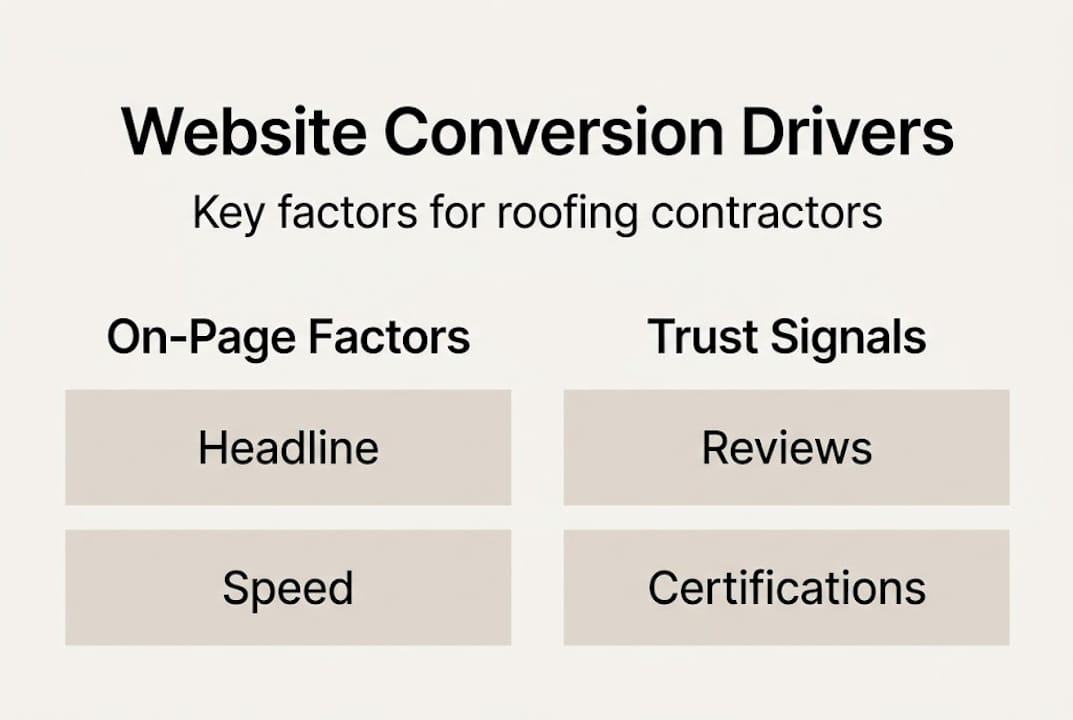
Here are the major drivers, ranked roughly by impact:
- Traffic quality and source. Visitors from organic search convert far better than social media clicks. Email traffic converts at 8 to 15%, while social traffic averages just 1 to 3%. If your paid traffic is not converting, suspect audience targeting before blaming your website.
- Mobile speed and usability. 53% of mobile users abandon a page that takes more than three seconds to load. Most roofing searches happen on phones. If your site is slow, you are bleeding leads every single day.
- Page type. A dedicated landing page built for a single offer converts at a completely different rate than a general blog post or a service overview page. Matching page purpose to visitor intent is one of the fastest wins available.
- Calls to action (CTAs). Vague CTAs like “Learn more” underperform specific ones like “Get your free roof inspection.” The more your CTA speaks to the visitor’s actual goal, the more it converts.
- Trust signals. Real photos, verified Google reviews, licensing badges, and before/after project galleries all reduce hesitation. Visitors need to trust you before they call you.
Pro Tip: Do not waste time testing button colors before you have tested your headline. Headline changes routinely produce 20 to 40 percent conversion lifts. Button color changes rarely move the needle more than 1 to 2 percent. Start with contractor lead generation strategies that focus on high-impact changes first.
One often-overlooked nuance: your page-level conversion rate will always look lower than your interaction-level rate. A page might show a 4% rate overall, but 40% of people who scrolled past the fold clicked your CTA. These two numbers tell very different stories, and understanding both helps you pinpoint exactly where visitors drop off. A well-built contractor website design accounts for all of these layers from the start.
How to boost conversions: Proven tactics for roofing and exterior contractors
With the factors in mind, here is what you can do right now to increase your conversion rate and sustain better performance over time.
Quick wins you can implement this week:
- Move your phone number and primary CTA button above the fold on every page.
- Add at least five recent, verified Google reviews to your homepage.
- Compress images and enable browser caching to cut load time below two seconds.
- Replace stock photos with real photos of your crew, vehicles, and completed jobs.
- Simplify your contact form to three fields: name, phone, and project type.
High-impact tests to run over 30 to 60 days:
- Rewrite your homepage headline to speak to the visitor’s biggest fear or desire, such as “We stop roof leaks fast, backed by a 10-year workmanship guarantee.”
- Add a risk-reversal statement near your CTA, something like “Free estimate, no obligation, no pressure.”
- Test a sticky header with your phone number on mobile devices.
- Add a short video (90 seconds or less) showing your process or a customer testimonial.
Tracking is non-negotiable here. Website conversion improvements only stick when you measure results against your established baseline. Without data, you are guessing.
Pro Tip: The quality of traffic you drive matters as much as what happens on the page. Use lead generation tips to attract buyers, not browsers. Higher intent traffic converts at higher rates regardless of what else you do. Pair quality traffic with contractor Facebook ad strategies to build a full-funnel approach. When you are ready to make structural improvements, conversion-focused website upgrades can help you build a site that works even while you sleep.
Our perspective: What most roofing contractors get wrong about website conversion
Here is the hard truth we see again and again: most roofing contractors blame their website design when the real problem is something else entirely.
A new color scheme or a refreshed logo will not fix a slow server, a confusing page structure, or traffic that was never qualified to begin with. Design is visible. Conversion strategy is not. That invisibility is exactly why it gets ignored.
The second big mistake is misattributing leads. A homeowner sees your yard sign, Googles your name, lands on your website, and calls you. You credit the website. But the real driver was offline brand awareness. When you misattribute leads, you make bad decisions about where to invest next.
The contractors who consistently grow focus on foundational improvements first: fast load times, clear offers, real trust signals, and traffic that is actually in-market. Short-term hacks like pop-ups or countdown timers can produce a short spike, but they rarely build lasting revenue. Looking at real-world contractor examples shows that sustainable conversion growth comes from getting the fundamentals right, then layering on optimization over time.
Get expert help to transform your contractor website conversion
If you have read this far, you already understand that website conversion is not a one-time fix. It is an ongoing process of testing, measuring, and improving.
Results Digital specializes exclusively in helping roofing and exterior contractors build websites and marketing systems that generate real, qualified leads. Whether you need a full contractor lead generation system or you want to start with a focused website audit, we can build a plan around your specific market and goals. Explore web design for roofers or review our full website design services for contractors to see how we approach conversion from the ground up. No long-term contracts. No generic templates. Just results.
Frequently asked questions
What is a good website conversion rate for roofing contractors?
Roofing contractors should realistically target a 5 to 10 percent conversion rate, which outperforms the general web average because roofing visitors typically arrive with stronger purchase intent.
What actions count as a website conversion?
Common contractor website conversions include form submissions, quote requests, and direct phone calls, all of which are trackable goals that represent a visitor taking a meaningful step toward hiring you. Defining these actions clearly in your analytics is the starting point for any improvement effort.
How can I calculate my website conversion rate?
Divide the total number of completed goal actions by your total website visitors, then multiply by 100. For example, 20 form submissions from 400 visitors equals a 5 percent conversion rate.
Why does my mobile website convert lower than desktop?
53% of mobile users abandon pages that take more than three seconds to load, and small screens make complex forms or unclear CTAs much harder to use, both of which significantly reduce mobile conversion rates.
