
Why Roofing Ads Get Disapproved: 2026 Guide
Roofing ad disapproval is defined as a platform’s automated or manual rejection of an ad based on policy violations, trust signal failures, or destination mismatches. Google Business Profile, Google Ads, and Meta Ads all flag roofing businesses at higher rates than nearly any other contractor vertical. The reasons are specific and preventable, but only if you know what platforms are actually measuring. This guide breaks down every major disapproval trigger across all three platforms so you can fix problems before they cost you leads.
Why roofing ads get disapproved more than other contractor ads
Roofing is the highest suspension vertical on Google Business Profile, surpassing locksmiths and garage door installers. Google trained its fraud detection models specifically on roofing patterns starting in 2018, and enforcement has only grown more aggressive in 2026. That history matters because it means your legitimate business gets evaluated against the same signals used to catch storm chasers and fake listing farms.
The core issue is trust. Platforms cannot physically verify that your crew exists, your address is real, or your claims are accurate. So they rely on proxy signals: address type, service area size, review velocity, landing page content, and user feedback. When those signals look like fraud patterns, the ad gets flagged. Many roofing ad disapprovals are not about roofing services specifically. They are about aggressive platform enforcement targeting high-risk trust signals that happen to cluster in the roofing vertical.
What Google Business Profile issues cause roofing ad disapprovals
GBP suspensions are the most damaging disapproval type because they pull your entire local presence offline, not just one ad. Understanding the specific triggers is the first step toward avoiding them.
The address problem most roofers don’t realize they have
34% of audited roofing Google Business Profiles are flagged due to storefront addresses that do not house actual roofing operations or equipment. That is the single most common hard suspension trigger across more than 400 suspended profiles. If your listed address is a home office, a UPS Store mailbox, or a shared coworking space, Google’s system reads it as a fake listing signal. Virtual office addresses account for 19% of suspended profiles in the same audit. The fix is documentation: photos of your actual location, utility bills, and business registration tied to a real operational address.
Service area, business name, and review velocity triggers
| GBP Trigger | Risk Level | What It Signals to Google |
|---|---|---|
| Storefront address with no operations | Hard suspension | Fake listing pattern |
| Virtual office or coworking address | Hard suspension | Location fraud |
| Service area beyond 2-hour drive radius | Soft suspension | Storm chaser behavior |
| Keyword stuffing in business name | Soft suspension | Spam profile |
| Rapid review acquisition | Soft suspension | Review manipulation |
| Phone number reused across profiles | Hard suspension | Multi-listing fraud |
Business name keyword stuffing is a top-3 cause of soft suspensions, appearing in 26% of audited suspended profiles. Outdated SEO advice told contractors to name their profile “Dallas Roofing Repair and Replacement Experts.” Google now treats that as a spam signal. Your GBP name should match your legal business name exactly.
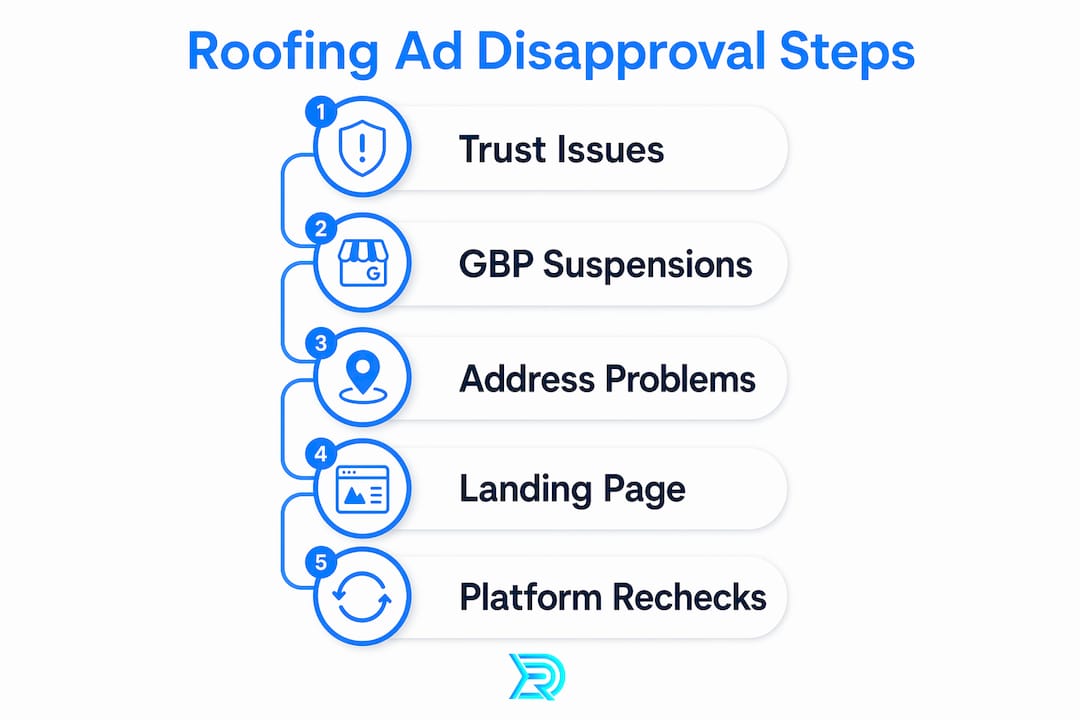
GBP enforcement escalates fast when multiple soft triggers combine. A profile with service area sprawl plus keyword stuffing in the business name can move from soft to hard suspension within one review cycle, requiring a formal reinstatement request with detailed documentation. That process can take weeks and costs you every lead generated through local search during that time.
Pro Tip: Document your physical location before you ever need it. Keep a folder with dated interior and exterior photos, a utility bill, and your business license tied to that address. If Google suspends your profile, that documentation is what gets you reinstated.
How Google Ads policies and landing page issues trigger disapprovals
Google Ads disapprovals operate on a different mechanism than GBP suspensions. Here, the platform evaluates your ad copy, your destination URL, and the experience a user gets after clicking. All three must align.
The most common roofing PPC disapproval triggers include:
- Destination mismatches: Approximately 28% of disapprovals relate to destination mismatches where the display URL does not match the actual landing page domain or the page content does not fulfill what the ad promises. A roofing ad promising “free roof inspection” that lands on a generic homepage triggers this immediately.
- Broken or slow-loading pages: Google’s crawler checks your landing page at the time of ad submission. A 404 error, a redirect chain, or a page that loads in over 5 seconds can cause automatic disapproval before a human ever reviews it.
- Misleading claims and unsubstantiated promises: 34% of policy rejections in 2026 involve misleading claims and unsubstantiated promises. Phrases like “best roofer in Texas,” “guaranteed lowest price,” or “100% satisfaction guaranteed” without supporting evidence on the landing page trigger this policy violation.
- Trademark misuse: Using competitor brand names or manufacturer trademarks in ad copy without authorization causes immediate disapproval.
- Prohibited content: Ads that imply urgency through fear tactics or make personal attribute references violate Google’s policies.
Landing page congruence is the factor most roofing advertisers underestimate. When your ad copy and landing page don’t align in messaging, offer, and service area, automated enforcement flags it as a misleading destination. If your ad says “Houston Roof Repair” but your landing page talks about services across all of Texas, that mismatch is enough to trigger disapproval.
Appeals are not a reliable safety net. Only about 54% of Google Ads disapproval appeals succeed, and the process typically takes 3 to 7 days. Getting the fix right before submission matters more than submitting fast. Review the specific policy cited in the disapproval notice, fix the exact issue, and submit a clear explanation of what changed.
Pro Tip: Before launching any roofing ad, open your landing page and read your ad copy side by side. Every claim in the ad should be supported by content on the page. If the ad says “licensed and insured,” the page needs to show your license number.
Why Meta roofing ads get rejected even after approval
Meta’s ad approval process is fundamentally different from Google’s. Initial review is largely automated and fast, often completing within minutes. That speed creates a false sense of security. The real enforcement happens after the ad is running.
Meta re-reviews many previously approved ads within the first 48 hours based on user feedback patterns. If enough users hide, block, or report your ad, Meta’s system flags it for re-evaluation. An ad that ran clean for two days can disappear on day three because of negative engagement signals. This is a feedback-driven enforcement model, not a one-time gate.
Common reasons Meta rejects roofing ads after initial approval:
- Negative user feedback: High rates of “hide ad” or “report ad” actions signal that users find the content irrelevant, misleading, or annoying. Meta treats this as a quality signal.
- Editing ads while running: Any ad edits during delivery trigger an automatic re-review cycle. Changing the headline, image, or budget on a live ad sends it back through the review queue, where it may be evaluated under updated policy interpretations.
- Personal attribute references: Roofing ads that imply knowledge of a user’s home condition (“We know your roof is damaged”) violate Meta’s personal attributes policy.
- Exaggerated claims: Phrases like “the best roofing company in [city]” or “we beat every competitor’s price” are flagged under misleading content policies.
- Changing enforcement interpretations: Meta updates its policy enforcement algorithms regularly. An ad approved under last month’s standards may fail under this month’s.
Meta’s ad compliance is not a one-time gate. The ecosystem automatically rechecks running ads based on user feedback and creative edits, unlike Google’s system which focuses primarily on destination matching. Monitor your ad feedback scores in Meta Ads Manager weekly. A relevance score drop or rising negative feedback rate is an early warning before a rejection hits.
How compliance signals compare across platforms
Understanding where each platform focuses its enforcement helps you prioritize fixes and avoid the mistakes that escalate from minor flags to full account penalties.
| Platform | Primary Enforcement Focus | Top Roofing Trigger | Escalation Risk |
|---|---|---|---|
| Google Business Profile | Location and identity trust | Fake or unverifiable address | Hard suspension, reinstatement required |
| Google Ads | Ad content and destination match | Landing page mismatch or misleading claims | Ad disapproval, account warning |
| Meta Ads | User engagement and feedback signals | Negative feedback post-approval | Ad rejection, account quality score drop |
GBP enforcement is the most severe because a hard suspension removes your entire local presence. Google Ads disapprovals are recoverable but costly in lost impressions and leads during the appeal window. Meta’s model is the most unpredictable because an ad can pass initial review and still get pulled based on how real users respond to it.
Storm-chasing patterns drive stricter enforcement across all three platforms. Roofing businesses that expand service areas aggressively after weather events, create multiple profiles, or rotate phone numbers match the exact behavior Google and Meta trained their systems to catch. Even legitimate contractors who operate in multiple markets need to structure their profiles and campaigns carefully to avoid triggering those same signals. The roofing Google Ads guide from Resultsdigitalus covers how to structure multi-market campaigns without triggering high-risk signals.
Key takeaways
Roofing ad disapprovals are caused by specific, identifiable trust signal failures across Google Business Profile, Google Ads, and Meta Ads, and every one of them is preventable with the right setup.
| Point | Details |
|---|---|
| GBP address verification | Use a real operational address with documentation ready before any suspension occurs. |
| Landing page congruence | Every ad claim must be supported by matching content on the destination page. |
| Meta feedback monitoring | Track negative feedback signals weekly to catch re-review risks before rejection hits. |
| Business name compliance | Use your legal business name only on GBP, with no keyword additions. |
| Appeal preparation | Fix the exact cited violation before submitting an appeal to maximize the 54% success rate. |
What we’ve learned managing roofing ad compliance at scale
At Resultsdigitalus, we’ve audited hundreds of roofing ad accounts, and the pattern is consistent. The contractors who get suspended or disapproved most often are not cutting corners intentionally. They followed advice that was accurate two or three years ago and never updated their setup. GBP policies around service areas and business names changed significantly after 2022, and many profiles still carry violations from that era.
The contractors who stay compliant treat GBP as infrastructure, not a one-time setup task. They review their profile quarterly, keep documentation current, and never make bulk edits during high-traffic periods. On the Google Ads side, the biggest preventable mistake we see is launching campaigns to a homepage instead of a dedicated landing page. That single decision causes more roofing PPC disapprovals than any policy violation.
Meta is where most roofing marketers get blindsided. They see initial approval and assume the work is done. It is not. Monitoring your Meta ad targeting performance and feedback scores is ongoing work, not a launch-and-forget task. The contractors who treat ad compliance as a continuous process rather than a checklist item stay live, stay visible, and keep generating leads while their competitors are filing reinstatement requests.
— Results
Stop losing leads to preventable ad disapprovals
If your roofing ads keep getting flagged, the problem is almost never the ad itself. It is the infrastructure behind it: the GBP setup, the landing page, the campaign structure, and the ongoing compliance monitoring.
Resultsdigitalus builds and manages roofing ad campaigns with compliance engineering built in from day one. From Google Ads management for roofers to SEO services for roofers, every campaign we run is structured to stay approved, stay visible, and generate qualified leads. We work exclusively with one roofing company per market, so your strategy is never shared with a competitor. No long-term contracts. Just results.
FAQ
Why do roofing ads get disapproved more than other trades?
Roofing is the highest suspension vertical on Google Business Profile because Google trained its fraud detection models specifically on roofing patterns since 2018. Storm chaser behavior, fake listings, and misleading claims in the industry created enforcement standards that affect all roofing advertisers.
What is the most common reason for a Google Business Profile suspension?
34% of suspended roofing GBP profiles are flagged because the listed address does not house actual roofing operations. Virtual office and coworking addresses account for an additional 19% of suspensions.
Can a Meta ad get rejected after it has already been approved?
Yes. Meta re-reviews many approved ads within the first 48 hours based on user feedback signals like hides, blocks, and reports. Editing an ad while it is running also triggers an automatic re-review that can result in rejection.
How do I fix a disapproved Google Ad for my roofing business?
Identify the specific policy cited in the disapproval notice, fix that exact issue in both the ad copy and the landing page, then submit an appeal with a clear explanation of the changes made. Only about 54% of appeals succeed, so fixing the root cause before submitting is critical.
What does landing page congruence mean for roofing ads?
Landing page congruence means every claim in your ad copy must be supported by matching content on the destination page. If your ad promises a free inspection, your landing page must prominently offer and explain that inspection.