
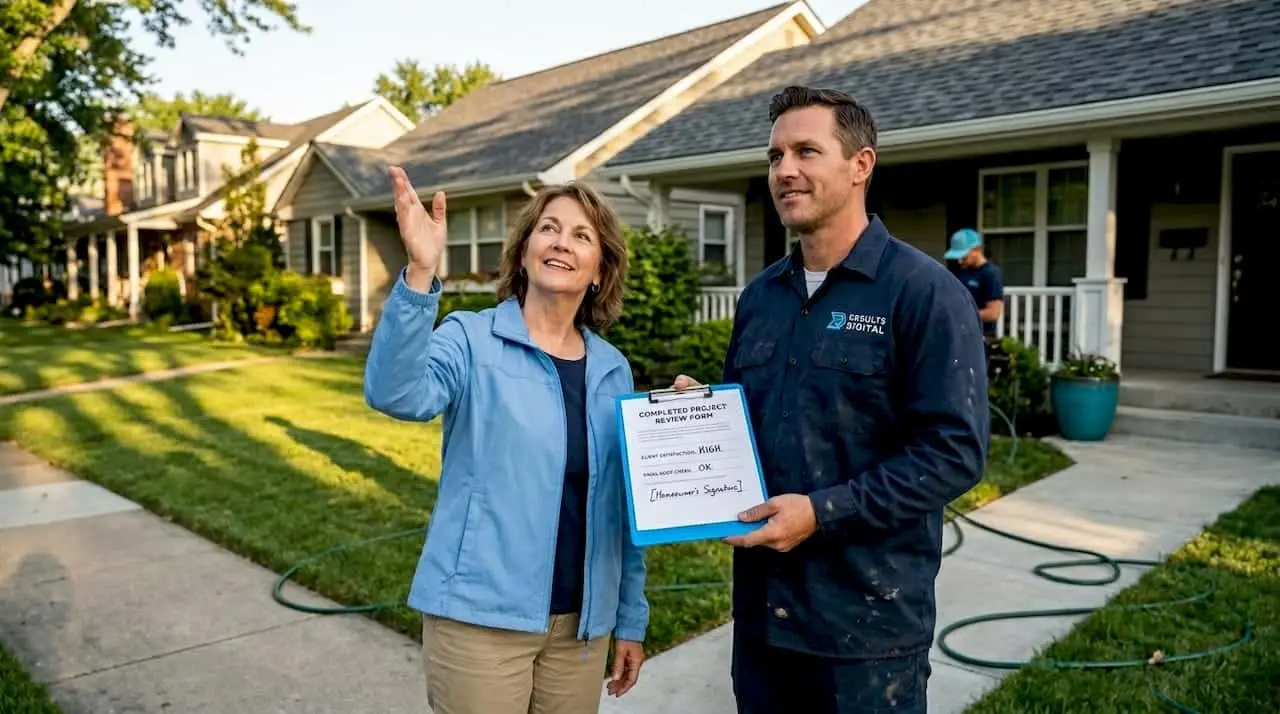
The Role of Testimonials in Roofing Marketing
TL;DR:
- Testimonials that include specific details and documented results build homeowner trust and improve conversion rates.
- Reviews significantly influence local SEO rankings, with recency and descriptive content boosting visibility and relevance.
Most roofing contractors collect a few Google reviews and call it done. But the role of testimonials in roofing marketing goes far deeper than a star rating on a search result page. When used with intention, testimonials influence your local search rankings, shorten your sales cycle, accelerate insurance approvals, and turn skeptical homeowners into booked jobs. The difference between a testimonial that converts and one that gets ignored comes down to specificity, placement, and how well your digital presence is built to showcase it. This guide breaks down exactly how to make testimonials your most powerful marketing asset.
Table of Contents
- Key takeaways
- The role of testimonials in roofing marketing and why it matters
- How testimonials affect roofing SEO and local rankings
- Formats of roofing testimonials that convert leads
- How to collect, manage, and showcase testimonials
- Common pitfalls when using testimonials in roofing marketing
- My take on the testimonial opportunity most roofers miss
- Turn testimonials into a lead generation engine
- FAQ
Key takeaways
| Point | Details |
|---|---|
| Specificity drives trust | Testimonials that name materials, problems solved, or timelines outperform generic praise every time. |
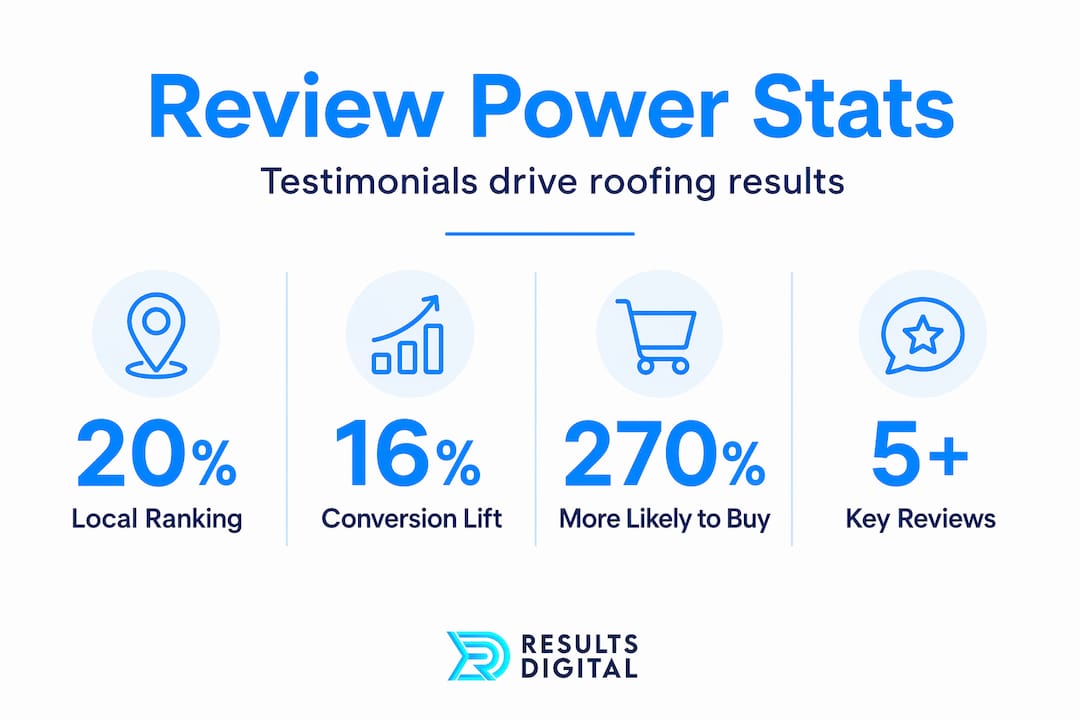
| Reviews shape local rankings | Customer reviews account for roughly 20% of local pack rankings, making them an SEO asset. |
| Schema markup multiplies visibility | Review schema with star ratings can increase your click-through rate by up to 87% in search results. |
| Responding to reviews boosts conversions | Engaging with every review leads to 16% higher conversion rates compared to ignoring them. |
| Compliance protects your rankings | Cherry-picking only five-star reviews in schema markup risks losing your rich snippets entirely. |
The role of testimonials in roofing marketing and why it matters
Roofing is a high-consideration purchase. A homeowner getting a new roof is likely spending $10,000 or more, dealing with storm damage stress, or navigating an insurance claim. They are not buying on impulse. They are researching, comparing, and looking for reasons to trust one company over another. That is where the social proof principle becomes critical.
When potential customers see that other homeowners in their area had a positive experience with your company, it lowers the perceived risk of hiring you. The impact of testimonials is measurable: moving from zero to five reviews increases purchase likelihood by 270%. That single statistic should change how seriously you take review collection.
Here is what makes a roofing testimonial genuinely useful versus forgettable:
- Specific materials mentioned: “They replaced our 20-year-old asphalt shingles with GAF Timberline HDZ and finished in one day” builds far more confidence than “great job.”
- Problem identified and solved: Testimonials that describe the original issue (leak, hail damage, failed inspection) and the resolution show competence in context.
- Timeline and process details: Mentioning how the crew cleaned up, communicated, or handled permits tells prospects what working with you actually feels like.
- Verified reviewer identity: Verified buyer reviews boost purchase likelihood by an additional 15% over anonymous testimonials, which is why Google reviews carry more weight than quotes on a static webpage.
Pro Tip: After every completed job, send the homeowner a short text that says: “We’d love to hear how it went. If you have 2 minutes, a Google review mentioning the project type and materials really helps our team.” Prompting specificity up front produces testimonials that actually move leads.
The importance of customer reviews also ties directly into how quickly decisions get made. Homeowners who encounter strong, detailed client feedback in roofing marketing reports move from inquiry to quote request faster. You are not just building credibility. You are compressing the time between first click and first call.
How testimonials affect roofing SEO and local rankings
Search engine optimization for roofing companies is not purely about keywords and backlinks. Reviews are a major ranking signal, and most contractors underestimate just how much weight Google places on them.
Reviews account for roughly 20% of local pack ranking factors in Google Maps results. That means your review volume, recency, and content are actively competing against other roofing companies for those top three spots. A contractor with 12 recent, detailed reviews will frequently outrank a competitor with 80 old, generic ones.
The text content inside reviews matters too, not just the star rating. When a homeowner writes “best roofing contractor in Austin for storm damage repair,” Google reads that as a relevance signal for exactly those search terms. Encourage customers to be descriptive, and your review section starts functioning like organic keyword content that you did not have to write yourself.
Schema markup: the technical edge most roofers ignore
Review schema is structured data you add to your website that tells Google how to display your ratings directly in search results. When implemented correctly, those gold stars appear next to your listing before a user even clicks. Review schema with star ratings can increase click-through rates by up to 87%, which means more traffic from the same search position.
| Schema approach | CTR impact | Risk level |
|---|---|---|
| No schema markup | Baseline | None |
| Properly implemented aggregate schema | Up to 87% CTR increase | Low (if compliant) |
| Cherry-picked positive reviews only | Short-term boost possible | High (manual penalty risk) |
| Dynamically generated, validated schema | Maximum sustained benefit | Low |
The compliance side of schema is where many roofing businesses make costly mistakes. Selective positive reviews in schema risk a manual action from Google, which strips your rich snippets entirely. Your schema must reflect aggregate sentiment, including less flattering reviews, and the data must be dynamically generated and validated so it stays accurate as new reviews come in.
Pro Tip: Use a developer or a specialized SEO service to implement review schema rather than doing it manually with a plugin. Stale or mismatched schema data is one of the most common reasons roofing websites lose their rich snippet visibility without knowing why.
Responding to reviews compounds the SEO benefit. Responding to all reviews leads to 16% higher conversion rates, and Google’s algorithm rewards active engagement. Every response you write signals that your business is alive, attentive, and trustworthy.
Formats of roofing testimonials that convert leads
Not all testimonials serve the same purpose, and using the wrong format in the wrong context costs you conversions. Understanding the strengths of each format helps you build a testimonial library that works across your entire marketing funnel.
Written testimonials are the most common and the easiest to collect. They work well on landing pages, proposal documents, and Google Business Profile. Their weakness is that they can feel generic if not curated carefully. A short, specific quote from a real homeowner with their first name, city, and project type converts far better than a paragraph of unattributed praise.
Video testimonials carry significantly more emotional weight. Seeing a real person describe how your crew handled their roof replacement after a hailstorm removes nearly all skepticism. Video testimonials perform exceptionally well on Facebook and Instagram ads, on your homepage, and in email follow-up sequences for warm leads. Even a 45-second phone-recorded clip from a satisfied customer outperforms a polished written quote.
Case studies are the most underused format in roofing marketing, and they deliver outsized value in two specific scenarios:
- When working with insurance claims, detailed testimonials tied to insurance cases reduce approval time and have been shown to raise job margins by thousands of dollars per project.
- When competing for commercial or high-value residential jobs, a one-page case study showing the problem, your solution, the materials used, and the outcome gives your proposal a credibility advantage that a competitor’s price quote simply cannot match.
Pro Tip: Segment your testimonials by project type on your website. A homeowner researching storm damage repair should see testimonials from other storm damage customers, not generic five-star reviews. Relevance multiplies persuasion.
The effectiveness of user reviews also depends on where you place them. Testimonials buried in a footer or stacked on a dedicated “Reviews” page that most visitors never reach are wasted. Place your three strongest testimonials on your homepage above the fold, directly adjacent to your primary call to action.

How to collect, manage, and showcase testimonials
Knowing testimonials matter is one thing. Building a repeatable system to collect them is what separates roofing businesses that grow from ones that plateau. Here is a practical sequence that works:
- Identify your advocates immediately after job completion. The best time to ask for a testimonial is within 24 to 48 hours of project completion, when satisfaction is at its peak. Do not wait for the invoice to clear.
- Make the ask specific and easy. Send a personalized text or email linking directly to your Google review page. Include a prompt: “Feel free to mention the type of work done and how the project went.” Specific prompts produce specific reviews.
- Use QR codes on job site signage and thank-you cards. A printed card with a QR code handed to the homeowner at project completion reduces friction significantly, especially for older homeowners less comfortable with digital outreach.
- Request video testimonials from your best customers. Identify homeowners who responded enthusiastically to the project and send a follow-up with a simple script. Most people will record a 60-second clip on their phone without hesitation if you make the request feel personal.
- Respond to every review within 48 hours. Thank positive reviewers by name and mention the specific project when possible. For negative reviews, acknowledge the concern, offer to resolve it offline, and keep your tone professional. Industry experts recommend treating review responses as both a reputation and SEO strategy, not just customer service.
- Audit your testimonial library quarterly. Remove outdated quotes, update your website with fresh reviews, and rotate case studies to reflect your current service mix.
The FTC requires that any testimonial used in advertising reflect honest, real experiences. Google’s review policies prohibit incentivizing reviews with discounts or gifts. Both rules exist for good reason. Fake or manipulated reviews damage your long-term credibility far more than a slow review collection rate ever would.
Common pitfalls when using testimonials in roofing marketing
Most roofing businesses that invest in testimonials still leave significant value on the table. The reasons are predictable, and avoiding them is straightforward once you know what to watch for.
- Generic praise does nothing. A quote that says “They were great and professional” gives a prospect zero information they could not have guessed. Specific, project-focused testimonials build trust faster because they prove competence, not just likability.
- Stale testimonials undermine credibility. A page full of reviews from 2019 sends the signal that your business has gone quiet. Recency matters both to prospects and to Google’s ranking algorithm.
- Mismatched schema data triggers penalties. If your website’s structured data shows a 4.9-star average but your Google Business Profile shows 3.8 stars, Google will notice the discrepancy. Dynamic schema generation solves this automatically.
- Ignoring negative reviews is a missed opportunity. A thoughtful, professional response to a critical review often impresses prospects more than a wall of five-star praise. It shows accountability.
The roofing businesses that dominate their local markets are not the ones with the most reviews. They are the ones with the most credible, specific, and well-placed testimonials working across every stage of the buyer journey.
Tracking the business impact of your testimonial strategy does not require complex analytics. Monitor changes in your local pack position, your website’s conversion rate on quote request forms, and the average quality of inbound leads. When those numbers move, you know the testimonials are working.
My take on the testimonial opportunity most roofers miss
I’ve worked with roofing contractors across competitive markets, and the pattern I see again and again is the same. Business owners know testimonials matter, but they treat them as a checkbox rather than a sales asset. They collect them passively, display them generically, and wonder why their conversion rate does not improve.
What I’ve found is that the roofing companies pulling the furthest ahead are doing something most of their competitors are not. They are treating each testimonial as a piece of strategic content. They match the right testimonial to the right page, the right prospect, and the right stage of the sales process. A homeowner filling out an insurance claim form should see a case study about a contractor who navigated that exact process. A prospect comparing prices should see a testimonial about value and workmanship that lasted.
The contractors I’ve seen close the biggest jumps in lead quality are the ones who integrate online branding for roofers with a deliberate testimonial strategy. They build trust before the first call ever happens. By the time a prospect picks up the phone, they already feel confident. That confidence shortens negotiations, reduces price shopping, and increases average job value.
My honest take: most roofing businesses have the raw material for a powerful testimonial strategy sitting in their email inboxes and old text threads. The work is in organizing, presenting, and amplifying it.
— Results
Turn testimonials into a lead generation engine
If this article made one thing clear, it is that testimonials are not passive reputation builders. They are active lead generation tools when placed, structured, and managed correctly.

At Resultsdigital, we work exclusively with roofing and exterior contractors to build the kind of digital presence that makes testimonials work harder. From roofing website optimization that integrates social proof directly into your conversion funnel, to SEO for roofing companies that turns your reviews into ranking signals, every service is built around generating real, measurable results. If you are ready to stop leaving leads on the table, explore how our digital marketing for contractors services can put your testimonials to work.
FAQ
How do testimonials affect roofing SEO rankings?
Reviews account for approximately 20% of local pack ranking factors in Google, making them a direct SEO signal. The text content in reviews also adds keyword relevance that supports your visibility in local search results.
What makes a roofing testimonial effective for converting leads?
Testimonials that mention specific project types, materials used, and problems solved convert far better than generic praise. Specificity is what builds buyer confidence and reduces the perceived risk of hiring an unfamiliar contractor.
How many reviews does a roofing company need to see results?
Moving from zero to five reviews increases purchase likelihood by 270%, according to research from Northwestern University’s Spiegel Research Center. Even a small collection of specific, verified reviews produces a measurable lift in conversions.
What is review schema and why should roofing businesses care?
Review schema is structured data that enables Google to display your star ratings directly in search results as rich snippets. Properly implemented schema can increase click-through rates by up to 87%, giving you more traffic without improving your ranking position.
Can a roofing business get penalized for cherry-picking reviews in schema?
Yes. Using only positive reviews in your schema markup while suppressing lower ratings violates Google’s policies and risks a manual action that removes your rich snippets entirely. Your schema must reflect the aggregate sentiment of all your reviews.