
TL;DR:
- Effective roofing ads require research to understand target audience fears and objections.
- Strong ad copy uses specific, benefit-driven language with clear calls to action and social proof.
- Continual testing and optimization of ad elements significantly increase lead conversions.
Running ads that eat your budget without generating a single call is one of the most frustrating experiences in the roofing business. You’re paying for clicks, but nobody’s booking. The problem usually isn’t your targeting or your budget. It’s your copy. The words you use in your ads determine whether a homeowner picks up the phone or scrolls right past you. This guide walks you through a proven, step-by-step process for writing roofing ad copy that converts, from laying the right foundation to testing what works and fixing what doesn’t.
Table of Contents
- What you need before you write: Foundations for roofing ad copy
- Step-by-step ad copywriting for roofers: The proven process
- Testing, tracking, and optimizing your ads for real results
- Avoiding common pitfalls: Rookie ad copy mistakes roofers make
- Lessons from the field: What most roofing ads miss
- Ready to supercharge your roofing ads?
- Frequently asked questions
Key Takeaways
| Point | Details |
|---|---|
| Know your audience | A deep understanding of your local market leads to ad copy that directly addresses real customer concerns. |
| Follow a clear process | A step-by-step approach—headline, benefits, CTA, trust—delivers higher-performing advertisements. |
| Test and optimize | Regularly test, track, and refine ads to maximize return on every dollar spent. |
| Avoid rookie mistakes | Steer clear of generic claims and missing CTAs to prevent wasted ad spend. |
| Leverage local trust signals | Highlighting local experience and reviews boosts credibility and attracts more customers. |
What you need before you write: Foundations for roofing ad copy
Strong ad copy doesn’t start with writing. It starts with research. Before you type a single word, you need a clear picture of who you’re talking to, what they’re afraid of, and why they should choose you over the five other roofers advertising in your market.
Know your audience and your core services. Are you targeting homeowners dealing with storm damage? Landlords managing rental properties? Homeowners planning a full replacement? Each group has different fears, different budgets, and different timelines. Your copy needs to speak directly to one of them, not all of them at once. Trying to appeal to everyone in a single ad is a guaranteed way to connect with no one.
Gather your customers’ real questions and objections. Think about what people ask when they call your office. “How long will it take?” “Are you licensed and insured?” “Do you work with insurance claims?” “What’s your warranty?” These aren’t just sales objections. They’re the exact phrases your ad copy should address. When your ad answers a question the homeowner is already asking, it immediately feels relevant and trustworthy.
Before you write a single ad, pull together these core assets:
- Photos: Before-and-after project photos, crew at work, finished roofs
- Testimonials: Written reviews and star ratings from Google or Facebook
- Your offer: Free estimates, same-day inspections, financing options
- Unique selling points (USPs): Years in business, local roots, certifications, warranties
- Proof of credibility: Licenses, insurance certificates, manufacturer certifications
Tools to help you research and write. Google’s search bar is your best free tool. Type in “roof repair [your city]” and look at what competitors are saying in their ads. Note what’s generic and what stands out. Tools like Google Keyword Planner show you what homeowners are actually searching for. For Facebook, the roofing Facebook ads basics approach means studying audience interests and pain points before you build your campaign.
Here’s a quick reference table for the assets you need and why they matter:
| Asset | Why it matters |
|---|---|
| Customer testimonials | Builds instant social proof and trust |
| Before/after photos | Shows tangible results, not just promises |
| Clear offer (e.g., free estimate) | Reduces friction and drives action |
| License and insurance info | Addresses the #1 homeowner fear |
| Local references | Makes your ad feel personal, not generic |
Pro Tip: Start a swipe file. Save screenshots of roofing ads you see in your region that catch your eye. Note what the headline says, what offer they’re making, and what imagery they use. You’re not copying them. You’re training your eye to recognize what works and what feels flat. After a few weeks, patterns will emerge that directly inform your own writing. As ServiceTitan notes, testing variations like A/B headlines and offers, then optimizing based on conversions like calls and form fills, is the foundation of any effective campaign.
Step-by-step ad copywriting for roofers: The proven process
With your materials organized, here’s how to engineer winning ad copy step-by-step.
1. Write a headline that stops the scroll. Your headline is doing the hardest job. It has about two seconds to earn the next two seconds. The best roofing headlines either name a pain point or create urgency. “Roof leaking after last night’s storm?” is infinitely more powerful than “Quality Roofing Services.” One speaks to a real moment in the homeowner’s life. The other says nothing memorable.
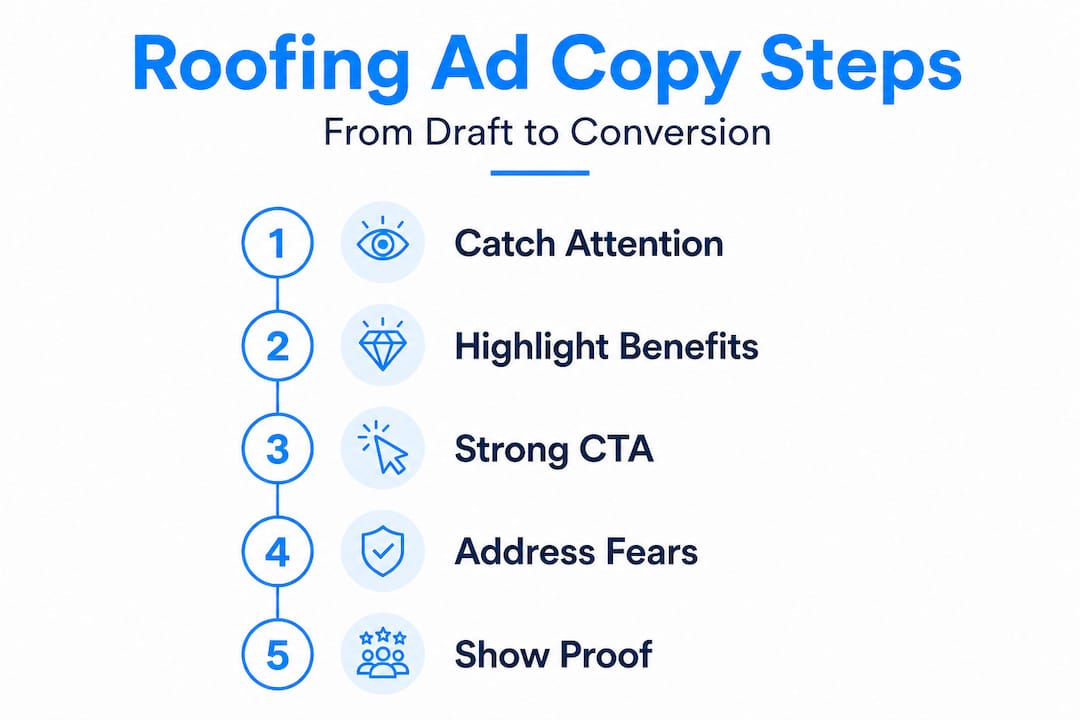
2. Lead with benefits, not features. Features are what you do. Benefits are what the homeowner gets. “30-year architectural shingles” is a feature. “A roof that protects your family for the next three decades without a single repair call” is a benefit. Homeowners don’t care about shingle grades. They care about peace of mind, dry ceilings, and not having to deal with this problem again.
3. Use a strong, specific call-to-action (CTA). “Learn More” is weak. “Book Your Free Estimate Today” is specific and action-oriented. “Call Now for a Same-Day Inspection” creates urgency. Your CTA should tell the homeowner exactly what to do and what they’ll get when they do it. Vague CTAs kill conversions.
4. Address fears directly. Roofing is a high-cost, high-trust purchase. Homeowners are afraid of getting ripped off, hiring unlicensed contractors, or having their roof replaced only to have leaks return. Your ad copy should acknowledge these fears and neutralize them. Phrases like “Licensed, insured, and backed by a 10-year workmanship warranty” do real work. So does “100% satisfaction guaranteed or we come back.”
5. Layer in social proof. Testimonials and review counts are powerful trust signals. If you have 200 five-star Google reviews, say so in your ad. “Trusted by 500+ homeowners in the Dallas area” tells a story that no amount of adjectives can match. For Facebook ad tips for roofers, incorporating real customer quotes into your ad creative consistently outperforms generic claims.
Here’s a comparison showing the difference between generic and high-converting copy:
| Element | Generic ad copy | High-converting ad copy |
|---|---|---|
| Headline | “Affordable Roofing Services” | “Storm damage? Get a free inspection today” |
| Body | “We offer quality roofing at great prices.” | “Licensed, insured, and trusted by 300+ local homeowners. No repair too big or small.” |
| CTA | “Contact us” | “Book your free estimate. We respond within the hour.” |
| Trust signal | None | “A+ BBB rating. 10-year workmanship warranty.” |
The difference is stark. One sounds like every other roofer. The other sounds like someone who understands exactly what the homeowner needs to hear. For Google Ads guidance for roofers, this same principle applies. Search ads with specific, benefit-driven headlines consistently outperform generic ones in click-through rate.
Pro Tip: Reference your local area explicitly. “Serving Tulsa homeowners for 12 years” or “We know Austin’s weather better than anyone” creates an instant connection that national brands can’t replicate. Homeowners want to hire someone who’s part of their community, not a faceless contractor from out of town. According to ServiceTitan, testing A/B headline variations and optimizing based on actual conversions like calls and form fills is how top-performing roofing campaigns continuously improve.
Testing, tracking, and optimizing your ads for real results
Once your ad is live, effective tracking and optimization are key to getting the most from each dollar spent.

Set up basic tracking first. Before you launch, make sure you can measure what matters. Set up call tracking so you know which ads are generating phone calls. Use form tracking in Google Analytics or your ad platform’s native tools to see which ads are driving quote requests. Without this, you’re flying blind. You might be spending $500 a week on an ad that’s never generated a single lead.
The metrics that matter most. Focus on these three numbers above everything else:
- Conversion rate: What percentage of people who click your ad actually call or fill out a form?
- Cost per lead (CPL): How much are you spending for each call or form submission?
- Click-through rate (CTR): What percentage of people who see your ad click on it?
A high CTR with a low conversion rate usually means your landing page is weak. A low CTR with a high conversion rate means your ad copy is too narrow but highly targeted. Understanding the relationship between these numbers tells you exactly where to fix things.
Run a weekly review process. Every week, pull your performance data and ask these questions. Which ad has the lowest CPL? Which headline is getting the most clicks? Which offer is driving the most form fills? Then act on what you find. Pause non-converters and scale winners weekly is the core discipline that separates profitable campaigns from money pits.
Here are the top optimization actions to take after reviewing performance:
- Pause any ad that hasn’t generated a conversion in 14 days
- Duplicate your best-performing ad and test one new element (headline, image, or CTA)
- Increase budget on ads with a CPL below your target threshold
- Add negative keywords in Google Ads to filter out irrelevant clicks
- Test a new offer (e.g., switch from “free estimate” to “free storm damage inspection”)
For a proper lead tracking setup, make sure your website is configured to capture every inquiry. Missed tracking means missed data, and missed data means wasted budget. Pairing strong ad copy with smart targeting strategies for roofers multiplies your results significantly. And don’t underestimate the power of customer reviews for roofing as a trust signal that feeds directly into your ad creative.
Avoiding common pitfalls: Rookie ad copy mistakes roofers make
Now, let’s make sure your campaign doesn’t fall into the traps that cost others precious leads.
The most common mistake is leaning on buzzwords that mean nothing. “Professional,” “quality,” “affordable,” and “reliable” appear in nearly every roofing ad in every market. When everyone says the same thing, no one stands out. These words don’t give the homeowner a reason to choose you. They’re filler that takes up space where real, compelling copy should live.
No clear CTA or next step. If your ad doesn’t tell the homeowner exactly what to do next, most of them won’t do anything. Every ad needs one clear action. Not two. Not three. One. “Call now,” “Book your free estimate,” or “Get your free inspection” are clean, direct, and effective.
Ignoring social proof. Homeowners read reviews before they call anyone. If your ad doesn’t reference your reputation, you’re missing a massive opportunity. Even a simple line like “Rated 4.9 stars by 180+ local homeowners” can dramatically increase trust and click-through rate. Check out roofing marketing best practices for more on how reputation drives conversions.
Copying competitors word-for-word. It’s tempting to model your ad after whoever’s running the most ads in your market. But if your copy looks and sounds identical to theirs, you give homeowners no reason to choose you. Unique messaging, rooted in your actual story and your actual customers’ words, wins every time.
Here’s a quick list of the most damaging mistakes to avoid:
- Using vague claims like “best in the business” without proof
- Running the same ad for months without testing anything new
- Sending ad traffic to your homepage instead of a dedicated landing page
- Forgetting to mention your service area in the ad itself
- Skipping mobile optimization for your landing page
“Roofers who regularly test and tweak ad copy see up to 40% more lead conversions.”
That number reflects what happens when you stop guessing and start optimizing. ServiceTitan’s data reinforces this. Testing A/B headlines, rotating offers, and optimizing based on actual conversions like calls and forms is what separates roofing companies that grow from ones that plateau. For a broader look at what works across the trades, general contractor ad strategies offer useful parallels that apply directly to roofing campaigns.
Lessons from the field: What most roofing ads miss
After learning what to avoid, consider this perspective rooted in years of real-world ad testing.
Here’s something most marketing guides won’t tell you. The biggest problem with roofing ads isn’t bad writing. It’s sameness. Open up Facebook or Google in any mid-sized city and look at the roofing ads. They all say the same things. “Licensed and insured.” “Free estimates.” “Quality work at fair prices.” After a while, they blur together into one undifferentiated mass of forgettable content.
The roofers who consistently outperform their competition aren’t necessarily better writers. They’re more specific. They mention the neighborhood where they just completed a job. They reference the hailstorm that hit two weeks ago. They use the exact words their best customers used in their five-star reviews. That level of specificity creates an emotional connection that generic claims simply cannot.
Hyper-local references are surprisingly powerful. “We just replaced 14 roofs in the Riverside Heights neighborhood after last month’s storm” is more compelling than any claim about quality or affordability. It tells the homeowner: we’re already here, we know your area, and your neighbors trust us. That’s a completely different message than “serving the greater metro area.”
The most underused tactic we see is borrowing language directly from customer reviews. Your best customers have already written your best ad copy. They’ve described their fears before hiring you, the relief they felt after the job was done, and the specific things you did that impressed them. Pull those phrases directly into your headlines and body copy. It’s authentic, it’s specific, and it resonates because it sounds like a real person, not a marketing department.
For a deep-dive on Facebook ad copy that covers creative strategy in detail, the core principle holds: specificity beats generality every single time.
Pro Tip: After every job, ask your customer one question. “What would you tell a neighbor who was thinking about hiring us?” Their answer is your next headline.
Ready to supercharge your roofing ads?
Writing great ad copy is a skill you can absolutely develop, and the framework above gives you a real head start. But if you’re running a roofing business, your time is better spent on jobs, not split-testing headlines.
That’s where Results Digital comes in. We specialize exclusively in digital marketing services for roofers, building targeted ad campaigns, high-converting websites, and lead generation systems that consistently fill your schedule with qualified jobs. Whether you want to sharpen your approach with lead generation tips for roofers or you’re ready for a fully managed campaign, we work with only one roofing company per market, so your growth is never competing with ours. If you want a web design for roofers that actually converts visitors into calls, we can build that too. Let’s talk about what’s possible in your market.
Frequently asked questions
What makes roofing ad copy different from ads for other home services?
Roofing ad copy should address urgent needs like leaks or storm damage and emphasize credibility because roofing is a high-cost, high-trust purchase that homeowners don’t take lightly.
How often should I test or update my roofing ads?
Review ad performance at least weekly, pausing non-converters and scaling winners to maximize ROI and keep your campaigns fresh and competitive.
How do I measure the success of my ad copy?
Track conversions like calls and form fills, then compare your cost per lead and conversion rate to benchmarks, since optimizing based on conversions is the most reliable path to improving results.
Is it worth hiring an agency for ad copywriting?
Agencies save time and deliver stronger results if you’re too busy to manage campaigns yourself, especially in competitive local markets where every wasted dollar matters.
What’s the most important element in effective roofing ad copy?
A clear, benefit-driven headline paired with a specific call-to-action motivates more homeowners to click, call, and book than any other single element in your ad.