

Local SEO guide for installers: Boost leads fast
TL;DR:
- Local search visibility is crucial for consistent roofing project leads and to outperform competitors.
- Optimizing your Google Business Profile with complete info, regular updates, and reviews enhances ranking.
- Building website authority through content clusters and earning local backlinks improves your overall search presence.
You could be the best roofer or exterior contractor in your city, but if you’re not showing up on Google when a homeowner searches “roof replacement near me,” that job is going to your competitor. Right now, local search visibility is the single biggest factor separating contractors who stay busy year-round from those scrambling for work. This guide walks you through exactly what you need to do, from setting up your Google Business Profile to building content authority, so you stop losing jobs to less-qualified competitors who simply know how to be found online.
Table of Contents
- Understanding local SEO basics for installers
- Setting up and optimizing your Google Business Profile
- Building authority with service-based content clusters
- Earning reviews and managing your reputation for maximum impact
- Why most local SEO advice for installers fails (and what actually works)
- Start dominating local search with expert help
- Frequently asked questions
Key Takeaways
| Point | Details |
|---|---|
| Complete your GBP | A fully completed Google Business Profile with up-to-date information is crucial for showing up in local searches. |
| Build content clusters | Cover your top 5-10 services with dedicated website clusters to establish topical authority and rank for relevant searches. |
| Update regularly | Frequent updates to your profile and content, including photos and posts, signal activity and boost visibility. |
| Respond to reviews fast | Reply to all reviews within 24 hours for a bigger trust and ranking bump. |
| Focus on local links | Pursuing links from local organizations and partners amplifies your website’s authority with search engines. |
Understanding local SEO basics for installers
To lay a strong foundation, let’s first clarify what local SEO really means for installers and why it’s the linchpin of local lead generation.
Local SEO is the process of making your business visible to people searching for your services in a specific geographic area. For roofing and exterior contractors, that means appearing in Google’s map pack (the three business listings that show up at the top of local search results) and on the first page of organic results when someone nearby searches for services you provide.
Google uses three core factors to determine local rankings:
- Proximity: How close your business is to the person searching
- Relevance: How well your business profile and website match what the searcher is looking for
- Authority: How trustworthy and established Google considers your business to be
Each of these factors requires a different set of actions. Proximity is partly fixed by your location, but you can expand your reach by targeting specific service areas. Relevance is controlled through your Google Business Profile (GBP) and your website content. Authority builds over time through reviews, backlinks, and consistent activity.
Here’s a quick breakdown of the key tools involved:
| Tool | What it does | Priority level |
|---|---|---|
| Google Business Profile | Drives map pack visibility | Critical |
| On-page website SEO | Ranks service pages in organic results | High |
| Local citations | Confirms business data across the web | Medium |
| Content clusters | Builds topical authority by topic | High |
| Backlinks | Signals trust and authority to Google | High |
Among these, your website’s content structure deserves special attention. Generic “roofing services” pages don’t cut it anymore. You need to build topical authority with content clusters organized around specific services like storm damage repair, flat roof installation, or gutter replacement, and earn local links from chambers of commerce, news outlets, and suppliers. These local SEO strategies have moved from optional to essential for contractors who want consistent inbound leads.
Pro Tip: Before doing anything else, audit your current online presence using Google Search. Search your exact business name and see what appears. Then search your top service plus your city and see where you land. This tells you exactly how far you have to go and in which direction.
Using this local SEO guide as your starting point, you can prioritize actions that deliver the fastest ranking improvements for your market.
Setting up and optimizing your Google Business Profile
With the basics covered, your next priority should be mastering your Google Business Profile—the heart of local search for service businesses.
Your GBP is often the very first thing a potential customer sees when they search for a contractor. If it’s incomplete, outdated, or missing services, you’re essentially handing jobs to your competition. Getting this right is non-negotiable.
Here’s how to set up and optimize your profile step by step:
- Claim your profile. Go to business.google.com and search for your business. If it already exists, claim it. If not, create a new listing. Complete the verification process, which usually involves receiving a postcard or phone call from Google.
- Fill out every single field. Business name, address, phone number, website URL, hours of operation, and service areas all need to be accurate and complete. Inconsistency in your name, address, and phone number (NAP) across platforms is one of the most common local SEO mistakes.
- Add all your real services. There’s an ongoing debate about whether to list every service or focus on your top five to ten, but listing all genuine services does not create a dilution penalty. The key is that every service listed in your GBP should have a corresponding landing page on your website.
- Upload high-quality photos. Before-and-after project photos, team photos, and photos of your vehicles or equipment all add credibility. Aim to add fresh photos consistently every single month.
- Write a keyword-rich business description. Mention your core services, the cities you serve, and any unique value you offer, such as financing, emergency service, or a satisfaction guarantee.
- Start posting regularly. Use Google Posts to share project highlights, seasonal promotions, and tips.
Here’s why activity matters more than most contractors realize:
| Activity level | Impact on GBP visibility |
|---|---|
| Active (posts + photos weekly) | Strong map pack presence |
| Moderate (updates every 2 weeks) | Solid but inconsistent visibility |
| Inactive (30+ days no updates) | Visibility drops sharply |
That third row should alarm you. If you go more than 30 days without updating your profile, your map pack rankings can decay significantly. The minimum to prevent this is 5 to 10 new photos per month and 2 posts per week.
“Your Google Business Profile is not a ‘set it and forget it’ asset. Think of it like a storefront window—if nothing changes, people stop looking.”
Your contractor digital presence starts here. Nail this, and you have a strong foundation for everything else.

Pro Tip: Link every Google Post to a specific landing page on your website, not just your homepage. This gives Google clearer relevance signals and sends visitors to pages optimized to convert them into leads.
Building authority with service-based content clusters
Now that your GBP is working for you, it’s time to make your website a true authority in your service area through smart content structure.
Most contractor websites have one generic “services” page listing everything they do. That approach treats Google like it’s 2012. Today, Google rewards websites that demonstrate deep, specific expertise on a topic. Content clusters are how you do that.
A content cluster works like this: you create one strong “pillar” page around a core service, such as asphalt shingle roofing, and then build several supporting pages or blog posts around related subtopics. Those might include “how long do asphalt shingles last,” “asphalt shingle vs. metal roofing,” or “what storm damage does to shingles.” Each supporting page links back to the pillar page, and the pillar page links out to the supporting content.
Here’s why this works so well:
- Google sees your website covering a topic from multiple angles, which signals true expertise
- Each supporting page targets its own set of long-tail keywords, pulling in more search traffic
- Visitors stay on your site longer when there’s more relevant content to read
- Internal links distribute authority across your pages, helping all of them rank better
Choose your five to ten core services first. For a roofing contractor, those might include storm damage repair, roof replacement, flat roofing, gutters, and skylight installation. For a siding or exterior contractor, you might focus on vinyl siding, fiber cement, window replacement, and soffit and fascia. These become your pillar topics.
| Content type | Purpose | Keyword focus |
|---|---|---|
| Pillar service page | Core service overview | “Roof replacement [city]” |
| Supporting blog post | Deep topic coverage | “How much does a roof replacement cost?” |
| FAQ page | Captures question-based searches | “How long does a roof last?” |
| Local area page | Targets nearby cities | “Roofing contractor in [suburb]” |
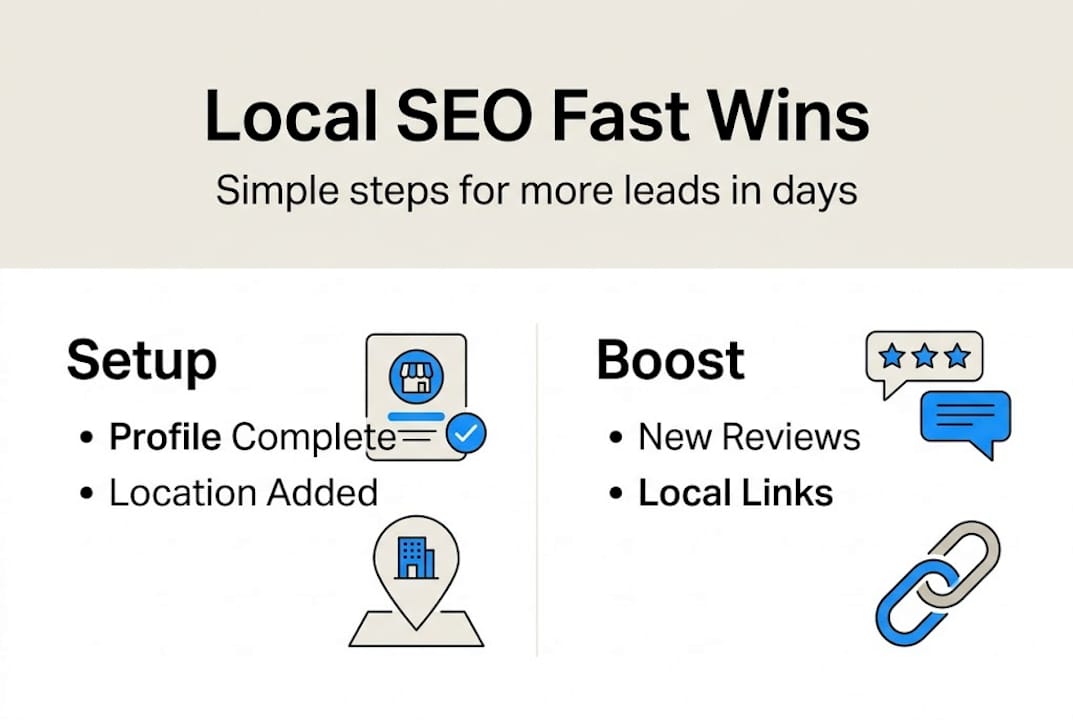
Once your clusters are in place, the next step is earning local links. These are backlinks from authoritative local websites pointing to your pages. This is how you build topical authority that goes beyond your own website and signals to Google that your business is genuinely respected in the community. Great sources include your local chamber of commerce directory, local news articles featuring your business, and supplier websites that list their authorized dealers or contractors.
For more strategies, explore these SEO tips for home improvement businesses, or get into the specifics with this contractor service area SEO guide.
Pro Tip: When writing supporting blog posts, always answer a specific question a homeowner would actually ask. Use the question as your page title, answer it clearly in the first paragraph, and then expand with detail. This format is what Google favors for featured snippets and AI-generated summaries in search results.
Earning reviews and managing your reputation for maximum impact
A strong content structure builds authority, but your reputation seals the deal—here’s how to turn positive customer experiences into search prominence.
Reviews are not just a trust signal for potential customers. They directly influence your Google rankings. More importantly, how and when you earn them matters as much as the total number.
Here is a proven process for generating reviews consistently:
- Ask at the right moment. The best time to ask for a review is within 24 hours of completing a job, while the experience is fresh and the homeowner is still impressed. Send a text message with a direct link to your Google review page.
- Make it effortless. Never ask someone to “find you on Google and leave a review.” Use a short link or QR code that takes them directly to the review form. Friction kills follow-through.
- Follow up once. If they haven’t left a review after three to five days, send one polite reminder. Keep it personal and reference their specific project.
- Respond to every review within 24 hours. This applies to both positive and negative reviews. Fast response boosts your prominence by 41% and shows potential customers that you’re attentive and professional.
- Handle negative reviews calmly. Respond with empathy, take responsibility where appropriate, and offer to resolve the issue offline. A well-handled negative review can actually increase trust more than ten more positive ones.
“A handful of recent five-star reviews beats a hundred old ones. Review velocity—how quickly you’re getting new reviews—matters as much as the total count.”
One thing that surprises many contractors: having a perfect 5.0 star rating is not always better than a 4.6 or 4.7. Google’s systems flag perfect 5.0 ratings as potentially inauthentic. A 4.5 or higher with steady new reviews every month is the sweet spot that earns both algorithmic trust and consumer trust.
Also, be cautious about suspicious reviews. If competitors are leaving fake negative reviews, you can flag them through Google and report patterns. Document everything and act through proper Google support channels.
Strong reviews are one of the most powerful contractor SEO tips you can act on immediately, and they compound over time as your reputation grows.
Pro Tip: Create a simple one-page handout you give every customer at project completion. Include your Google review link as a QR code, a short thank-you note, and a line that says “your feedback helps local homeowners find trusted contractors.” This physical touchpoint often generates reviews that a text message alone would miss.
Why most local SEO advice for installers fails (and what actually works)
Here’s the uncomfortable reality: most local SEO advice given to roofing and exterior contractors is recycled from general marketing guides that have no idea how your business actually works. The advice sounds logical on paper but fails in practice because it misses what actually drives results in your market.
The biggest mistake we see is contractors copying their top competitors’ websites and GBP profiles. That strategy puts you in second place at best. Your competitors are not your blueprint. They’re your benchmark. Your goal is to identify what they’re not doing and fill that gap aggressively.
The second mistake is treating your Google Business Profile as a one-time setup task. The service-based SEO approach that actually works requires consistent, ongoing activity. Profiles go stale. Rankings decay. You have to treat your GBP like a social media account for your business, posting regularly and updating photos constantly.
The third mistake is trying to be everything to everyone. Contractors who list 25 services and build 25 generic service pages end up ranking for none of them well. Focusing on your five to ten most profitable services, building deep content around each one, and dominating those specific searches produces far better results than spreading thin across everything you technically offer.
Finally, the data is clear on reviews: quantity without velocity is a dead end. We’ve seen contractors with 200 reviews lose map pack rankings to competitors with 60 reviews, simply because those competitors were earning new reviews every week while the first contractor had gone months without a new one. Speed and consistency matter more than raw numbers.
Start dominating local search with expert help
Ready to take your local SEO game to the next level? Here are your next steps.
You’ve got the roadmap. Now it’s about consistent execution. If you’re serious about turning your website and Google profile into a lead-generating machine, Results Digital works with contractors and trades of all kinds, from roofing and exterior contractors to HVAC, plumbing, electrical, and general contractors. We know your market, your customers, and what it takes to win locally. Start with the local SEO step-by-step guide built specifically for service contractors, or dive into actionable contractor SEO tips you can implement this week. When you’re ready for hands-on help, our SEO: AI + Maps program is built for your industry.
Frequently asked questions
How long does it take to see results from local SEO for installers?
Most installers see some ranking improvements in 1 to 3 months, with significant lead growth in 4 to 6 months depending on competition and how consistently they implement the strategies.
Should I list all my services in Google Business Profile or only the main ones?
List every real service your business offers in your GBP, but make sure each service is matched by a dedicated page on your website for best results.
How often should I update my Google Business Profile?
Update at least every two weeks, and aim for a minimum of 5 to 10 photos per month with 2 posts per week to maintain strong visibility and prevent ranking decay.
Does getting all 5-star reviews help my ranking?
A 4.5-plus star average with steady, consistent review growth is actually preferred. Google’s systems flag perfect 5.0 ratings as potentially inauthentic, which can reduce trust rather than build it.
What’s the best way to get local links for installer websites?
Focus on earning backlinks from local chambers, news sources, and suppliers. These location-specific and industry-relevant links build far stronger authority than generic directory links.
Recommended
- Local SEO Guide for Service Contractors: Dominate Search