
TL;DR:
- PPC offers targeted leads by capturing homeowners actively searching for roofing services.
- Top campaigns optimize for closed deals and high-quality leads rather than just low cost per lead.
- Proper tracking, keyword management, and campaign structure are essential for PPC success.
Many roofing contractors write off pay-per-click advertising the moment they hear a $350 cost per lead. That number sounds steep until you realize the job it closes is worth $12,000. Pay-per-click advertising is a model where you pay only when someone clicks your ad, not just to show it. For roofing and exterior contractors, that distinction matters enormously. This guide breaks down exactly how PPC works, what it realistically costs in your market, and how the best-performing roofing campaigns turn ad spend into booked jobs without guessing.
Table of Contents
- What is pay-per-click (PPC) advertising?
- How does PPC work? Auctions, ad rank, and targeting essentials
- What does PPC actually cost for roofing and exterior contractors?
- Expert strategies: How roofers can win with PPC in 2026
- PPC in the real world: Common pitfalls and how to avoid them
- Our take: The real reason most roofing PPC campaigns fail
- Ready to turn clicks into booked roofing jobs?
- Frequently asked questions
Key Takeaways
| Point | Details |
|---|---|
| PPC delivers high-intent leads | Roofing contractors can generate quality leads by targeting searchers at the exact moment they need services. |
| Benchmark metrics drive smarter strategy | Know your average cost per click and lead to set realistic budgets and goals. |
| Negative keywords and tracking are vital | Using negative keywords and tracking all leads ensures you only pay for real opportunities. |
| Quality Score improves ROI | Optimizing ad relevance can cut your costs in half and boost campaign success. |
| Avoid common PPC pitfalls | Control wasted spend and improve results by carefully managing match types and resolving tracking errors. |
What is pay-per-click (PPC) advertising?
PPC is straightforward in concept: you run an ad, and you only pay when someone clicks it. No click, no charge. That makes it fundamentally different from a billboard or a radio spot where you pay regardless of whether anyone responds.
For roofing and exterior contractors, this model fits naturally into your marketing mix. You are not trying to build brand awareness with millions of impressions. You need homeowners who are actively searching for a roofer right now. PPC puts your business in front of those people at the exact moment they are ready to call.
Here is where PPC can show up for your business:
- Google Search Ads: Appear at the top of results when someone searches “roof repair near me” or “storm damage roofer”
- Google Display Ads: Banner ads shown across websites your prospects visit
- Performance Max campaigns: Google’s automated format that spans search, display, YouTube, and more
- Social media ads: Facebook and Instagram ads targeting homeowners by location and behavior
For roofing contractors, Google Ads is the primary platform for capturing high-intent local searches. Someone typing “emergency roof repair” is not browsing. They have a problem and need a contractor today.
PPC is also not simply pay-to-play. It operates on a bid-based auction system, which means a bigger budget does not automatically mean the top spot. Ad relevance, landing page quality, and historical performance all factor in. A well-optimized campaign from a mid-sized roofing company can consistently outrank a competitor spending twice as much. That is the opportunity most contractors miss when they dismiss PPC as too expensive. Learning roofing PPC basics before launching a campaign saves you from costly early mistakes.
Stat to know: Google processes over 8.5 billion searches per day. A meaningful slice of those are homeowners looking for local contractors right now.
How does PPC work? Auctions, ad rank, and targeting essentials
Every time someone searches a keyword you are bidding on, Google runs an instant auction. It happens in milliseconds, and your ad either wins a position or it does not. Understanding how that auction works is what separates contractors who profit from PPC and those who burn through budget.
Your position in that auction is determined by Ad Rank, and Ad Rank is calculated from three core inputs: your bid amount, your Quality Score, and your expected click-through rate. Bid is just one piece.
Quality Score (scored 1 to 10) reflects how relevant your ad and landing page are to the keyword being searched. A score of 8 to 10 is your target. Here is why it matters so much in roofing:
| Quality Score | Estimated CPC Impact |
|---|---|
| 3 or below | Pay up to 400% more per click |
| 5 to 6 (average) | Pay the baseline rate |
| 8 to 10 (excellent) | Pay up to 50% less per click |
Think about what that means. Two contractors bidding the same dollar amount can pay wildly different prices per click based purely on relevance. Targeting is equally critical. Roofing keywords are expensive, so showing your ad to the wrong audience is a fast way to drain your budget.
Here is how a basic Google Ads auction plays out:
- A homeowner searches “roof replacement cost” in your city
- Google identifies all advertisers bidding on that keyword
- Each advertiser’s Ad Rank is calculated in real time
- Ads are ranked and displayed based on Ad Rank, not just bid
- You are charged only if the user clicks your ad
Pro Tip: Improving your Quality Score from a 5 to an 8 can cut your cost per click nearly in half without increasing your bid. Start by tightening the match between your ad copy and your landing page.
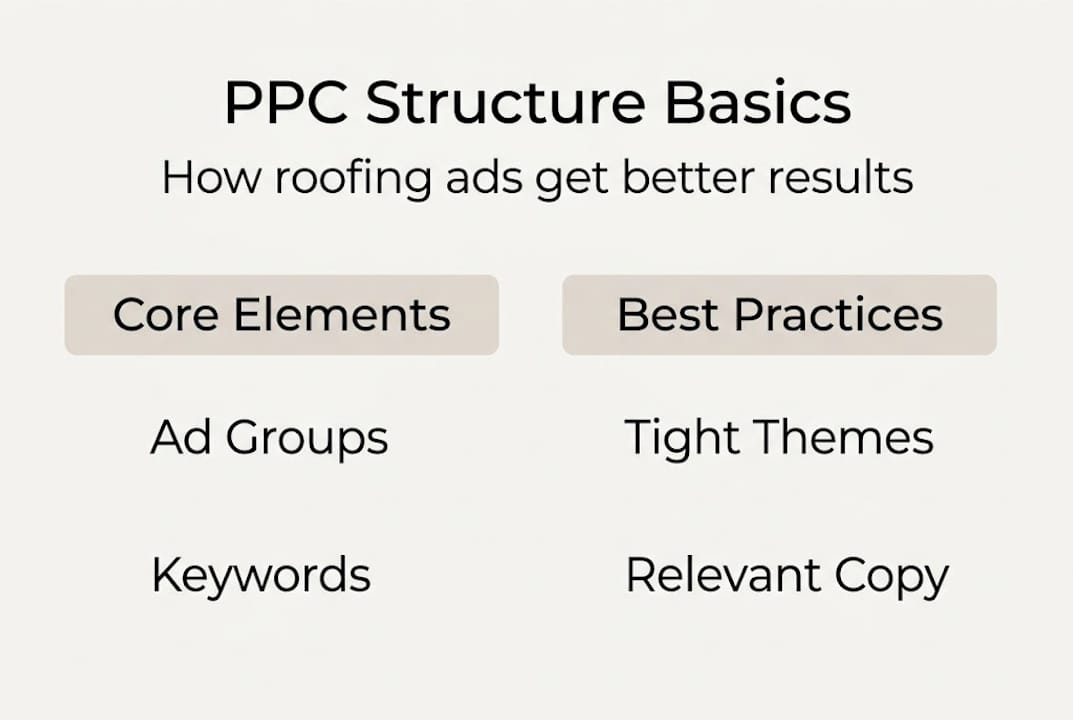
The campaign structure for roofing you build from day one shapes your Quality Score. Grouping keywords tightly by service type, writing ads that match those keywords exactly, and sending traffic to a dedicated landing page for each service are the three levers that move Quality Score fast. Choosing the right PPC ad formats for each campaign type also plays a role in how well your ads perform.
What does PPC actually cost for roofing and exterior contractors?
Let’s talk real numbers. For roofing and exterior contractors, average CPC runs $25 to $50, with an average cost per lead around $350 and a conversion rate near 5.58%. Top-performing campaigns, however, achieve a cost per lead as low as $67 by maintaining Quality Scores of 8 to 10.

That gap between $67 and $350 per lead is not luck. It is the result of tighter targeting, better ad copy, and relentless negative keyword management.
Here is a quick benchmark comparison to frame your expectations:
| Metric | Industry Average | Top Performers |
|---|---|---|
| Cost per click (CPC) | $25 to $50 | $15 to $25 |
| Cost per lead (CPL) | $350 | $67 |
| Conversion rate | 5.58% | 10%+ |
| Quality Score | 5 to 6 | 8 to 10 |
But here is the number most contractors ignore: lead value. A $350 CPL sounds painful until you consider what the lead is worth.
- Emergency repair: Average job value $400 to $800. A $350 CPL is tight but workable.
- Full roof replacement: Average job value $10,000 to $20,000. A $350 CPL is a bargain.
- Gutters or siding: Average job value $2,000 to $6,000. A $350 CPL is solid ROI.
When you factor in lead quality in PPC, the math changes completely. Chasing the lowest CPL without knowing what those leads close into is a trap. Automated bidding strategies like Target CPA or Target ROAS can help, but use automated bidding only with 50+ conversions per month or you risk the algorithm optimizing on too little data. Review your roofing PPC benchmarks regularly and consider working with PPC experts who specialize in your industry to close the gap between average and top-performer results.
Expert strategies: How roofers can win with PPC in 2026
Knowing the benchmarks is useful. Knowing how to beat them is what actually grows your business. The top-performing roofing PPC campaigns in 2026 share a handful of common practices that most contractors overlook.
Split your budget by job type. Separate campaigns for emergency repair (allocate roughly 60% of budget here), roof replacement, and maintenance perform far better than one catch-all campaign. Emergency repair searches convert fast. Replacement searches need more nurturing. Mixing them in one campaign confuses the algorithm and your messaging.
Build a serious negative keyword list. Most roofing contractors start with a handful of negatives. Top performers use 500 to 1,000 negative keywords to block irrelevant traffic. Searches like “roofing jobs,” “DIY roof repair,” and “roofing supply store” will eat your budget if you let them. Negative keywords for roofers deserve as much attention as the keywords you are bidding on.
Track calls and forms separately. Without granular tracking, you cannot tell which campaigns generate real leads versus tire-kickers. Call tracking software tied to your Google Ads account shows you which keywords drive phone calls that convert. That data is what lets you cut waste and double down on what works. Explore the right PPC campaign types for your tracking setup.
Use Performance Max carefully. Performance Max campaigns can lower CPL by 34% when structured with tight audience signals and strong creative assets. But without proper setup, they can also serve your ads to irrelevant audiences. Monitor placement reports closely.
Pro Tip: Stop optimizing for cost per lead. Optimize for cost per closed deal. A campaign with a $200 CPL that closes 10% of leads beats a $100 CPL campaign that closes 3%. Connect your CRM data to your ad account and measure what actually matters.
Seasonality also matters. High competition drives CPC spikes after storm events, sometimes pushing costs to $35 to $60 per click overnight. Plan budget reserves for storm season so you can capitalize when demand surges instead of going dark. Review Google Ads best practices regularly as the platform evolves.
PPC in the real world: Common pitfalls and how to avoid them
Even a solid strategy falls apart when execution has gaps. These are the mistakes we see most often in roofing PPC accounts, and each one is fixable.
- Broken or missing tracking. If your conversion tracking is not set up correctly, Google has no signal to optimize toward. You end up paying for clicks with no way to know which ones turned into calls or form fills. Audit your tracking setup before spending a dollar.
- Broad match keywords without conversion data. Broad match can expand your reach, but it also matches your ads to searches you never intended. Without enough conversion data to guide the algorithm, broad match wastes budget fast. Start with exact and phrase match, then layer in broad match once you have data.
- Negative keyword conflicts. This one surprises contractors. If you add “free” as a negative keyword at the campaign level but have “free roof inspection” as a positive keyword in an ad group, you block your own ad. Review your negative lists carefully for conflicts before publishing.
- Ignoring seasonal budget planning. Storm damage surges are predictable in most markets. Contractors who do not plan for them either overspend in slow months or run out of budget when demand peaks. Build a seasonal budget calendar tied to your local weather patterns.
- Sending all traffic to the homepage. Your homepage is not a landing page. A homeowner searching “roof leak repair” should land on a page dedicated to that exact service, with a clear call to action and a phone number above the fold.
“Inconsistent tracking skews data more than any other single factor in roofing PPC. Fix your measurement first, then optimize.”
If your current campaigns have any of these issues, get expert help from someone who works exclusively with roofing and exterior contractors. Generic PPC agencies often miss the nuances that make or break campaigns in your industry.
Our take: The real reason most roofing PPC campaigns fail
After working exclusively with roofing and exterior contractors, we have seen a pattern that no benchmark report captures. Most roofing PPC campaigns do not fail because of high CPCs or tough competition. They fail because contractors optimize for the wrong metric.
The industry obsesses over cost per lead. Agencies pitch low CPL as proof of performance. But a $90 lead that never closes is more expensive than a $400 lead that books a $14,000 replacement. When you chase CPL without connecting it to closed revenue, you end up cutting the campaigns that actually make you money.
The contractors who win with PPC treat it like a sales system, not an advertising channel. They know their close rate by campaign. They know their average job value by keyword. They make budget decisions based on cost per booked job, not cost per click. That shift in thinking changes everything about how you build, manage, and scale a PPC account.
The other thing most articles will not tell you: PPC rewards patience in the first 90 days and ruthlessness after that. The first three months are about gathering data. After that, every decision should be backed by numbers. Cut what does not close. Scale what does. The contractors who stick with that discipline are the ones who build a predictable pipeline from paid search.
Ready to turn clicks into booked roofing jobs?
If you have made it this far, you understand that PPC is not a gamble. It is a system. And like any system, it performs better when it is built by people who know your industry inside and out.
At Results Digital, we work exclusively with roofing and exterior contractors. We do not split our focus across industries, and we never work with two competing contractors in the same market. Every campaign we build is designed around one goal: booked jobs, not just clicks. From campaign structure to call tracking to negative keyword lists, we handle the details that move the needle. If you are ready to stop guessing and start scaling, let’s talk about what a results-driven PPC strategy looks like for your market.
Frequently asked questions
Why is PPC more expensive for roofing and exterior contractors?
Roofing keywords attract intense local competition because the job values are high, pushing average CPC to $25 to $50. The good news is that a single closed replacement job can return 30 to 50 times the cost of the lead.
How do I get more high-quality leads from PPC?
Separate your campaigns by job type, build a large negative keyword list, and track every call and form submission. Separate campaigns by job type so your budget flows toward the services with the highest job value and close rate.
What’s a good PPC cost per lead for roofing companies in 2026?
The industry average CPL is around $350, but top campaigns hit $67 CPL by maintaining high Quality Scores and aggressive negative keyword management. Focus on cost per closed job, not just cost per lead.
Should I use automated bidding for my PPC campaigns?
Automated bidding requires 50+ conversions per month to work reliably. Below that threshold, manual bidding gives you more control and prevents the algorithm from optimizing on bad data.
Is tracking calls and forms really necessary for PPC success?
Yes, without it you cannot connect ad spend to real booked jobs. Track calls and forms from day one so every optimization decision is based on what actually generates revenue, not just clicks.